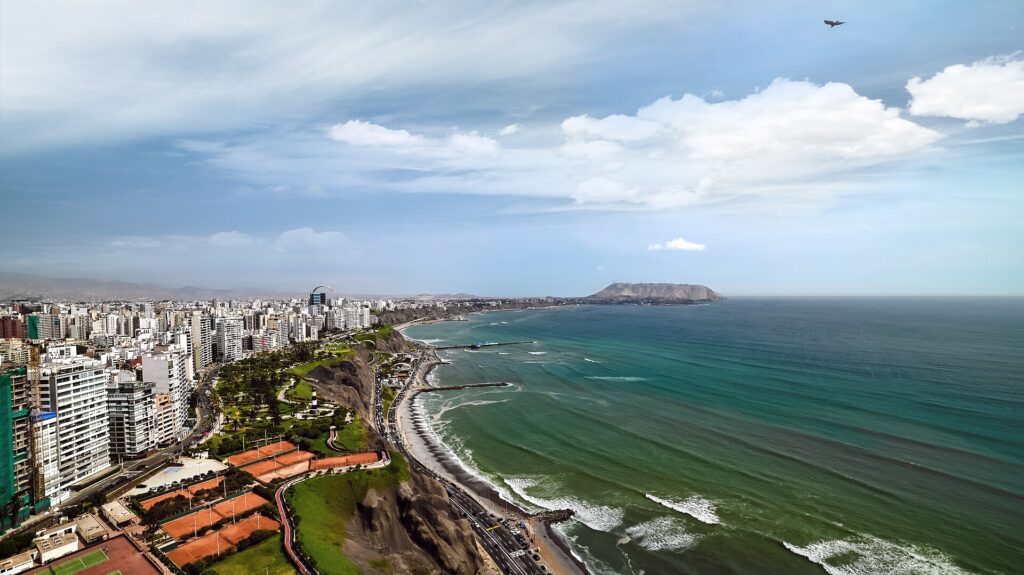
The best things to do in Lima, Peru sit in three clusters, and a first visit should touch all of them. In the colonial historic center, walk from Plaza San Martín to the Plaza Mayor, catch the changing of the guard at the presidential palace and go down into the catacombs under San Francisco. On the coast, walk the Miraflores clifftops, visit Huaca Pucllana, an adobe pyramid older than the Incas that sits between apartment blocks, and finish the day in Barranco. Then give half a day to Museo Larco, the clearest introduction to ancient Peru in the city. In between, eat ceviche at lunch.
This guide is for first-time visitors with two to four days, which is how long most people stay: PROMPERÚ’s 2024 survey of foreign tourists found a median of three nights in Lima. The constraint that shapes every plan here is traffic. TomTom’s 2025 Traffic Index puts the average 10 km drive in metropolitan Lima at almost 35 minutes, and more than 51 minutes in the evening rush, so the sights below are grouped by area, with realistic times and the day each one closes. Prices, hours and closures were checked on September 24, 2026, against the venues’ and agencies’ own websites.
On this page: At a glance · What to do first · How Lima fits together · Historic center · Miraflores · Barranco · Museums · Food · After dark · Farther out · What to skip · Timing and closures · Getting around safely · Accessibility · FAQ
Lima Attractions at a Glance
Costs are the standard adult price for a foreign visitor in Peruvian soles (S/), as checked on September 24, 2026. Map numbers match the map in the next section, and the time to allow is our own planning estimate, based on tour lengths the venues publish where they give one.
| Map | Attraction | Adult cost | Time to allow | Closed | Best time |
|---|---|---|---|---|---|
| 1 | Plaza Mayor and the changing of the guard | Free | 45 minutes | During security closures | By 11:30 a.m., for the noon ceremony |
| 1 | Cathedral of Lima | S/ 30 | 1 hour | Sunday mornings | Weekday morning |
| 1 | San Francisco convent and catacombs | Pay at the door | 1 hour, guided | Open daily | Morning |
| 1 | Santo Domingo convent | S/ 15 | 45 minutes | Mondays, and 1 to 2 p.m. | Before 1 p.m. |
| 1 | Casa de Aliaga | S/ 35, plus a guide | 45 minutes | Open daily, 10 a.m. to 4 p.m. | With a guided tour |
| 2 | MALI, the Lima Art Museum | S/ 40 | 2 hours | Mondays | Afternoon |
| 3 | Magic Water Circuit | S/ 7 | 1.5 hours | Open daily, 3 to 10 p.m. | After dark |
| 4 | Museo Larco | S/ 50, or S/ 45 online | 2 to 3 hours | Open daily | Any day until 7 p.m. |
| 5 | Huaca Pucllana | S/ 15 by day, S/ 17 at night | 1 hour | Tuesdays | Morning, or an evening visit |
| 6 | Parque Kennedy | Free | 30 minutes | Always open | Evening |
| 7 | Malecón clifftop walk and Parque del Amor | Free | 1 to 2 hours | Always open | Late afternoon |
| 7 | Tandem paragliding | S/ 260 to S/ 300 | 1 hour, with the wait | When the wind is wrong | 10 a.m. to sunset |
| 8 | Larcomar | Free to walk in | 30 minutes | Mall hours | Sunset |
| 9 | LUM, the Place of Memory | Free | 1.5 hours | Mondays | Afternoon |
| 10 | Barranco’s Bridge of Sighs | Free | 1 hour | Always open | Late afternoon |
| 10 | MAC Lima (contemporary art) | S/ 20 | 1.5 hours | Mondays | Afternoon |
| 10 | Museo Pedro de Osma | S/ 35 | 1.5 hours | Mondays | Morning |
| Off map | Pachacamac sanctuary | S/ 15 | Half a day | Mondays | Morning |
| Off map | Palomino Islands sea lions | From about S/ 160 on a tour | Half a day | Rough seas | Morning departures |
What Should You Do First in Lima?
If you only have two days, build them around five things:
- The historic center on foot. Start mid-morning so you reach the Plaza Mayor before noon, then see the Cathedral and the San Francisco catacombs.
- The Miraflores clifftops at the end of the day. Walk the Malecón to Parque del Amor and watch the paragliders come in over the Costa Verde.
- Museo Larco. Thousands of years of ancient Peruvian history, told mostly through pottery, gold and textiles, and open every day until 7 p.m.
- Huaca Pucllana. A pre-Inca adobe pyramid in the middle of Miraflores, with a guided walk included in the S/ 15 ticket. It’s closed on Tuesdays.
- A long lunch at a cevichería, and dinner in Barranco. Food isn’t a side activity in Lima; it’s one of the main things to do.
That list differs from what most visitors actually do. In PROMPERÚ’s 2024 survey, 46% of foreign tourists in Lima visited the historic center, 39% went to Parque Kennedy and 38% went to Larcomar, which is a shopping mall. Only 8% made it to Museo Larco and 5% to Huaca Pucllana. We’d swap those numbers around.
After the core, choose by interest. History fans should add Santo Domingo, Casa de Aliaga and the Pachacamac sanctuary south of the city. Art lovers have MALI, MAC Lima and the colonial paintings at Museo Pedro de Osma. Anyone curious about modern Peru should give 90 minutes to LUM, the free museum of the 1980 to 2000 internal conflict. If you’d rather move than look, fly a tandem paraglider off the cliffs, take a surf lesson on the Miraflores beaches or ride a boat out to the sea lions of the Palomino Islands.
How Lima Fits Together (and Why Traffic Decides Your Day)
Metropolitan Lima is enormous, but the parts a visitor needs form a rough line. The historic center sits inland, on the south bank of the Rímac River. About 10 km south by road, Miraflores and Barranco run along cliffs above the Pacific. Museo Larco is in Pueblo Libre, a residential district west of the line between them. Callao, with the port, the airport and the boats to the Palomino Islands, lies farther west, and the Pachacamac sanctuary is 24 km by road south of Miraflores.
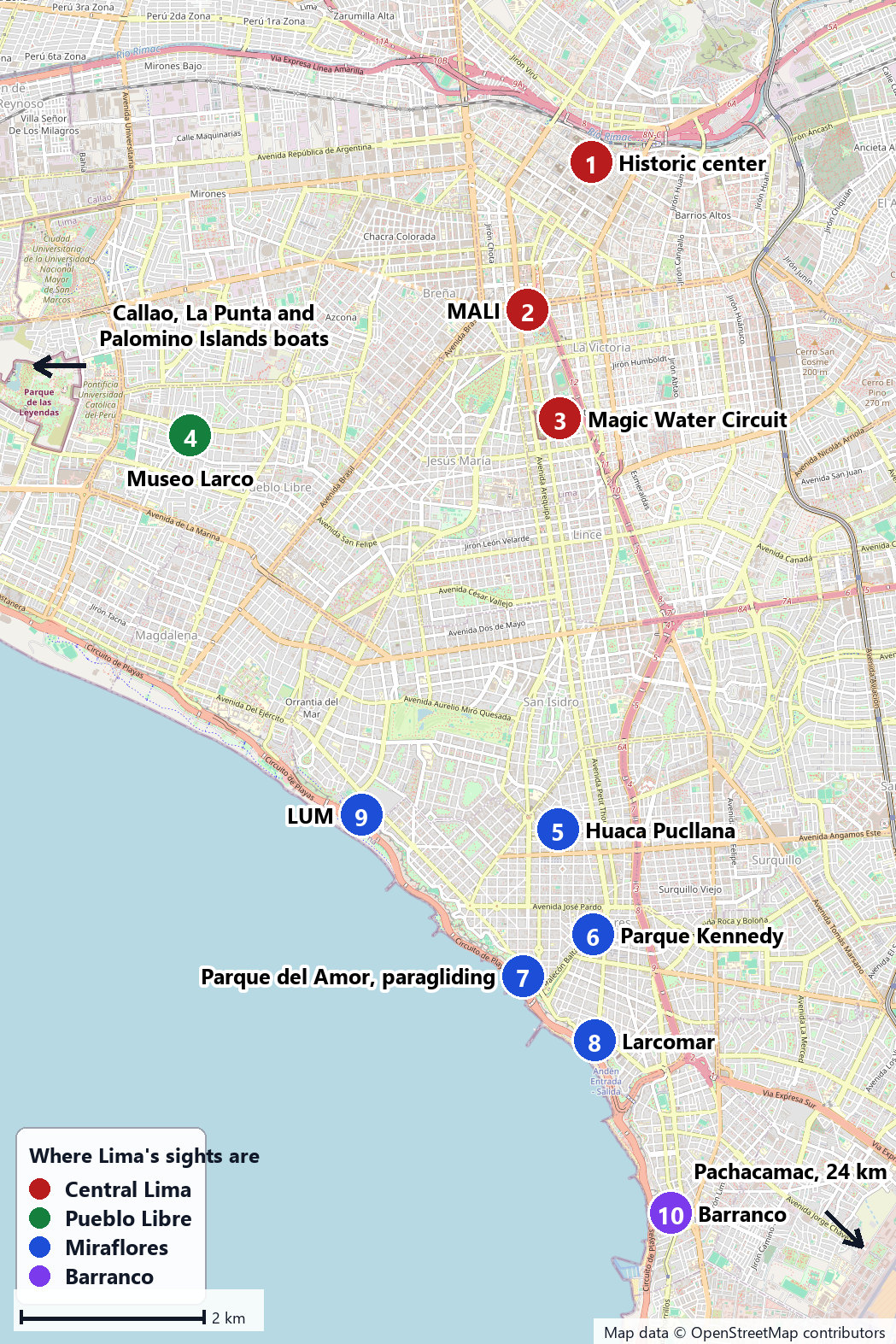
Nothing on that map is far in kilometers. It’s the driving that takes time. We measured road distances between the main areas on OpenStreetMap routing and applied TomTom’s 2025 averages for metropolitan Lima: 34 minutes 53 seconds per 10 km across the whole day, and 51 minutes 17 seconds in the evening rush hour.
| Trip | Road distance | Typical drive | Evening rush hour |
|---|---|---|---|
| Plaza Mayor to Parque Kennedy, Miraflores | 9.7 km | About 34 minutes | About 50 minutes |
| Plaza Mayor to Museo Larco | 7.6 km | About 27 minutes | About 39 minutes |
| Plaza Mayor to the Magic Water Circuit | 3.8 km | About 13 minutes | About 20 minutes |
| Parque Kennedy to Museo Larco | 9.9 km | About 35 minutes | About 51 minutes |
| Parque Kennedy to the Magic Water Circuit | 7.2 km | About 25 minutes | About 37 minutes |
| Parque Kennedy to Barranco’s Bridge of Sighs | 4.5 km | About 16 minutes | About 23 minutes |
Those are averages. A taxi at 8 a.m. on a Sunday will beat them, and one at 6 p.m. on a Friday may not. The practical rule is one area per half day: the historic center in the morning, the coast in the afternoon and evening, and Larco on a separate morning or late afternoon. Between Miraflores and the center at rush hour, the Metropolitano, the bus rapid transit line that runs in its own lanes down the Vía Expresa, is usually faster than a car. A ride costs S/ 3.20, paid with a rechargeable card.
The Historic Center: Plazas, Churches and Catacombs
Francisco Pizarro founded Lima in 1535, and the grid he laid out around the Plaza Mayor is still the heart of the city. UNESCO listed the San Francisco convent in 1988 and extended the World Heritage Site to the wider historic center in 1991. It’s flat and walkable, and most of what’s worth seeing is within 15 minutes on foot of the main square. Come in daylight, and plan around lunch: some churches and convents close for an hour in the early afternoon.
One warning before you go. The center is where Lima protests, and the authorities close it when they expect trouble. From June 19 to 22, 2026, the Municipality of Lima and the police sealed off the whole historic core ahead of demonstrations, including the Plaza Mayor and Plaza San Martín, and the nearby Metropolitano stations closed. If you find fences across the streets, save the center for another day.
Plaza Mayor and the Changing of the Guard
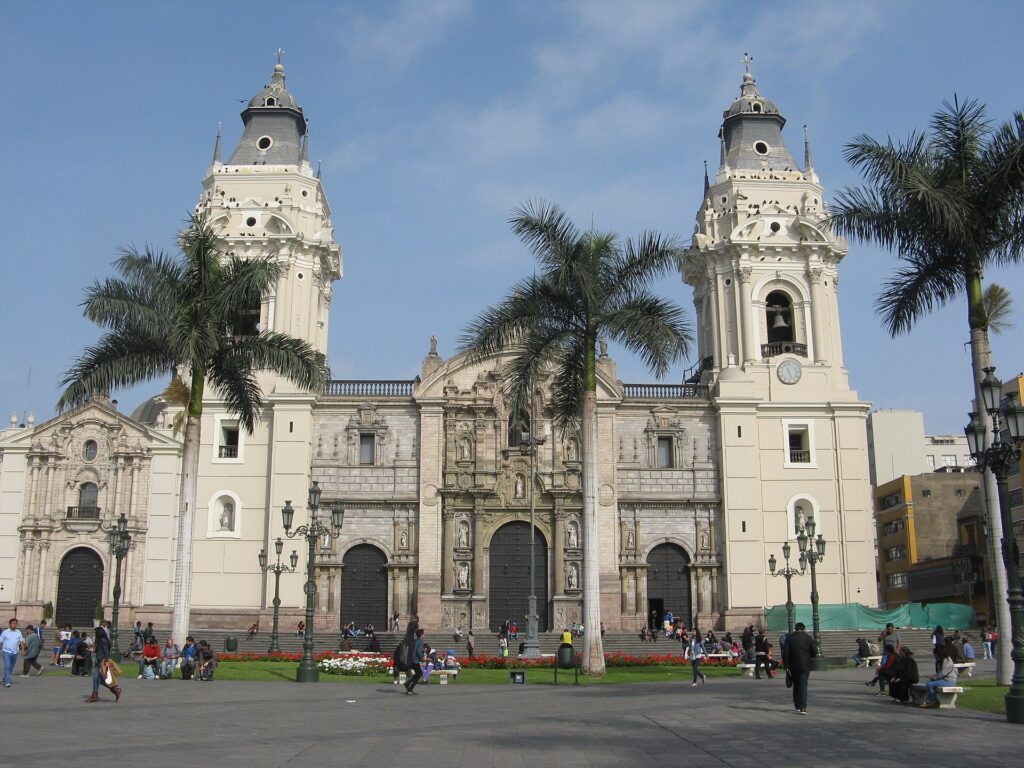
Also called the Plaza de Armas, the square is ringed by the city’s grandest buildings: the Government Palace on the north side, the Cathedral and the Archbishop’s Palace on the east and the yellow Municipal Palace, with its carved wooden balconies, on the west. At midday the palace guard changes in a ceremony you watch through the railings from the plaza. A band usually starts playing beforehand, so arrive by 11:30 a.m. to get a spot at the fence. It’s free, and security measures can cancel it without notice.
Plan it: free and open, apart from security closures. Allow 45 minutes, more with the ceremony. The plaza and its sidewalks are flat and paved.
Cathedral of Lima
Earthquakes have knocked down Lima’s cathedral more than once, and the building you see is the product of centuries of rebuilding. Inside are side chapels thick with gilded altarpieces, carved choir stalls and the chapel holding the remains attributed to Pizarro himself. The religious art museum is part of the visit. Tickets are sold online in timed slots or at the door.
Plan it: S/ 30 for foreign adults, S/ 15 for foreign children aged 6 to 12, free under 6. Open Monday to Friday 9 a.m. to 8 p.m., Saturday 10 a.m. to 10 p.m. and Sunday 1 to 7 p.m. Allow an hour.
San Francisco Convent and Catacombs
The Franciscan complex, two blocks from the plaza, is the one place in the center you shouldn’t skip. Visits are guided, take about an hour and run in Spanish or English. You walk through cloisters lined with painted tiles, a library of old books that looks like a film set, and then down into the catacombs, where bones from the colonial cemetery beneath the church are laid out in rows and patterns. It’s more eerie than gruesome.
Plan it: open daily from 9 a.m. The convent’s own website gives closing times from 6 p.m. to 9 p.m. depending on the page, so arrive before 5 p.m. to be safe. Tickets are sold at the entrance and prices aren’t posted online, so bring cash in soles. The catacombs are underground; ask at the door if stairs are a problem.
Santo Domingo
One block from the plaza, the Dominican convent holds the relics of Lima’s two best-known saints, Santa Rosa de Lima and San Martín de Porres, along with cloisters covered in Spanish tiles. The ticket includes a guided visit and the bell tower, which is limited to visitors aged 18 and older on the orders of Peru’s civil defense authority.
Plan it: S/ 15. Open Tuesday to Sunday, 9 a.m. to 1 p.m. and 2 to 5 p.m.; closed Mondays. Allow 45 minutes.
Casa de Aliaga
This colonial mansion near the Government Palace has been in the same family since the land was granted in the 1530s, and walking through its patios and salons is the best way to see how Lima’s elite lived. It works differently from a museum: the house has no guides of its own, so you need to come with an official guide or on a tour that includes it.
Plan it: S/ 35 per person, open daily 10 a.m. to 4 p.m. Groups and agencies book by phone or email through the house’s website.
Jirón de la Unión and Plaza San Martín
Jirón de la Unión is the pedestrian street that links the Plaza Mayor with Plaza San Martín, about 950 m, or 13 minutes on foot, to the south. It’s a shopping street, busy and a little worn, with fine old facades above the chain stores. Plaza San Martín, with its equestrian statue of the independence hero José de San Martín and its uniform early 20th-century buildings, is the other great square of the center and a good place to start a walk.
Barrio Chino and the Mercado Central
Chinese immigrants began arriving in Peru in the 19th century, and their cooking merged with Peruvian ingredients into chifa, which Limeños now eat as naturally as ceviche. Lima’s Chinatown fills the blocks around Jirón Ucayali and Calle Capón, next to the Mercado Central, the city’s main market. Both are packed and noisy. Go at lunchtime, eat at a chifa, and keep your phone in a front pocket.
Casa de la Literatura Peruana
Behind the Government Palace, the old Desamparados railway station now houses a museum and library devoted to Peruvian literature. The building alone justifies a short stop, and it’s free.
Plan it: free. Open Tuesday to Sunday, 10 a.m. to 7 p.m.; closed Mondays. Allow 30 minutes.
A Walking Route Through the Center
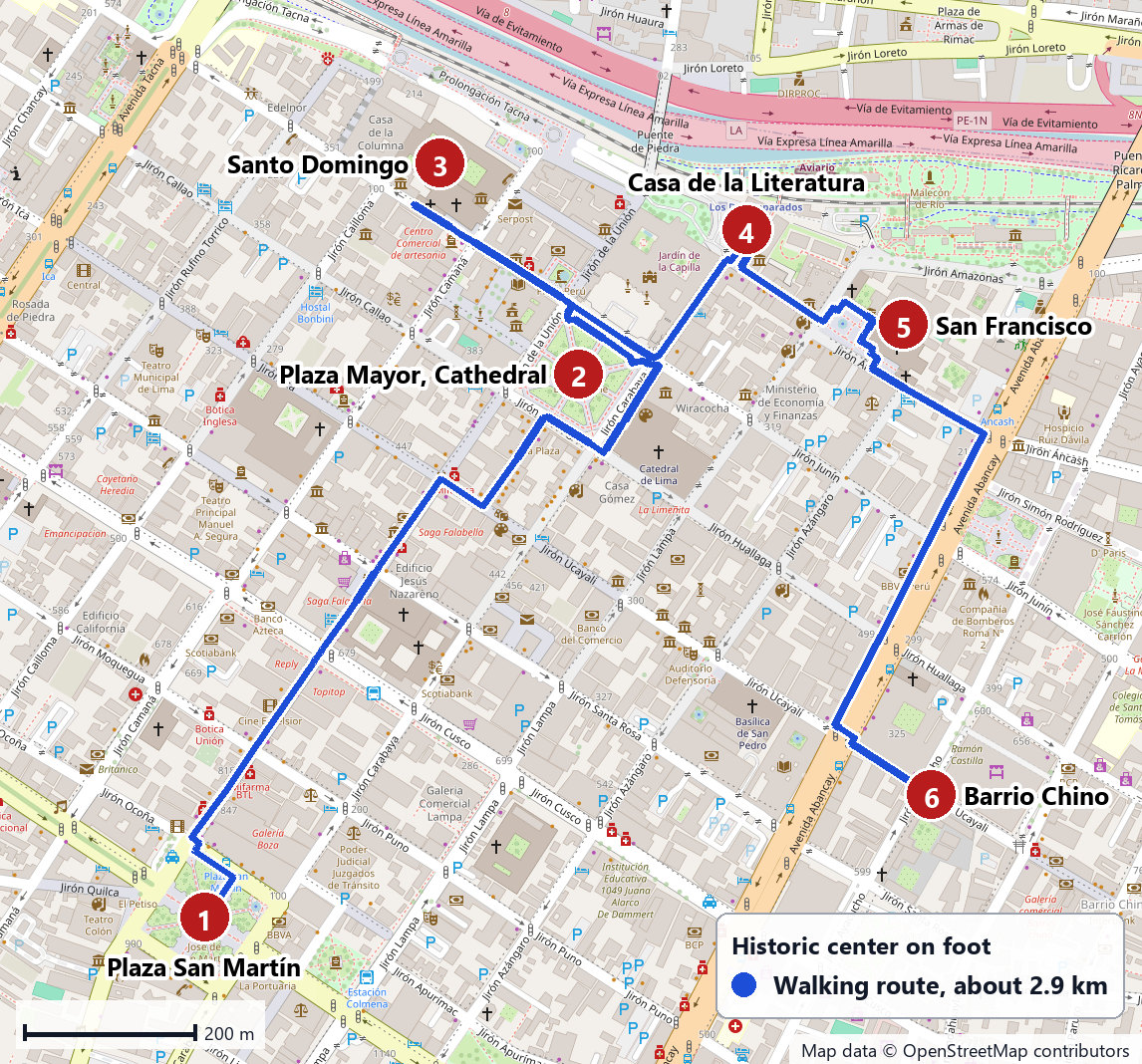
This route links the sights above in an order that works with their hours. Start at Plaza San Martín at about 10 a.m., see the Cathedral before the changing of the guard, reach Santo Domingo before it closes at 1 p.m., and finish in Barrio Chino for a late lunch. It works best Tuesday to Saturday: on Sundays the Cathedral opens at 1 p.m., and on Mondays Santo Domingo is closed. Walking distances come from OpenStreetMap routing.
| Stop | Walk from the previous stop | What to do | Time to allow |
|---|---|---|---|
| 1. Plaza San Martín | Start | Look around the square, then walk north on Jirón de la Unión | 15 minutes |
| 2. Plaza Mayor and Cathedral | 950 m, about 13 minutes | Cathedral visit, then the changing of the guard around noon | 1.5 to 2 hours |
| 3. Santo Domingo | 440 m, about 6 minutes | Cloisters, the saints’ relics and the tower | 45 minutes |
| 4. Casa de la Literatura | 540 m, about 7 minutes | Exhibits in the old railway station | 30 minutes |
| 5. San Francisco | 240 m, about 3 minutes | Guided visit to the cloisters, library and catacombs | 1 hour |
| 6. Barrio Chino | 760 m, about 10 minutes | Chifa lunch and the Mercado Central | 1 hour |
With visits, the whole loop fills five to six hours. Police sometimes close the streets immediately around the Government Palace, so be ready to walk an extra block. When you’re done, take an app taxi from a main street rather than hailing one.
Miraflores: Clifftops, a Pyramid and Paragliders
Miraflores is the Lima most visitors picture: apartment towers and parks lined up along the top of the cliffs, the Pacific below and surfers in the water. It’s easy to spend your whole trip here. Don’t. But do give it an afternoon and an evening.
The Malecón and Parque del Amor
The Malecón is the chain of clifftop parks and paths that runs 5.4 km through Miraflores, from the San Isidro boundary to Barranco. The best-known stop is Parque del Amor, the Park of Love, where couples pose under El Beso, Víctor Delfín’s huge sculpture of a kissing couple, surrounded by benches covered in colorful mosaic. From about December to April the sunsets over the ocean are often clear, and the clifftop is the obvious place to watch them. In the gray months the light is softer, and the sunset is often a rumor.
Plan it: free and always open. The clifftop path is paved and mostly level, with a bike lane along much of it. Parque del Amor to Larcomar is about 1 km, or 13 minutes on foot; allow an hour or two if you stop to watch the paragliders.
Paragliding Over the Costa Verde
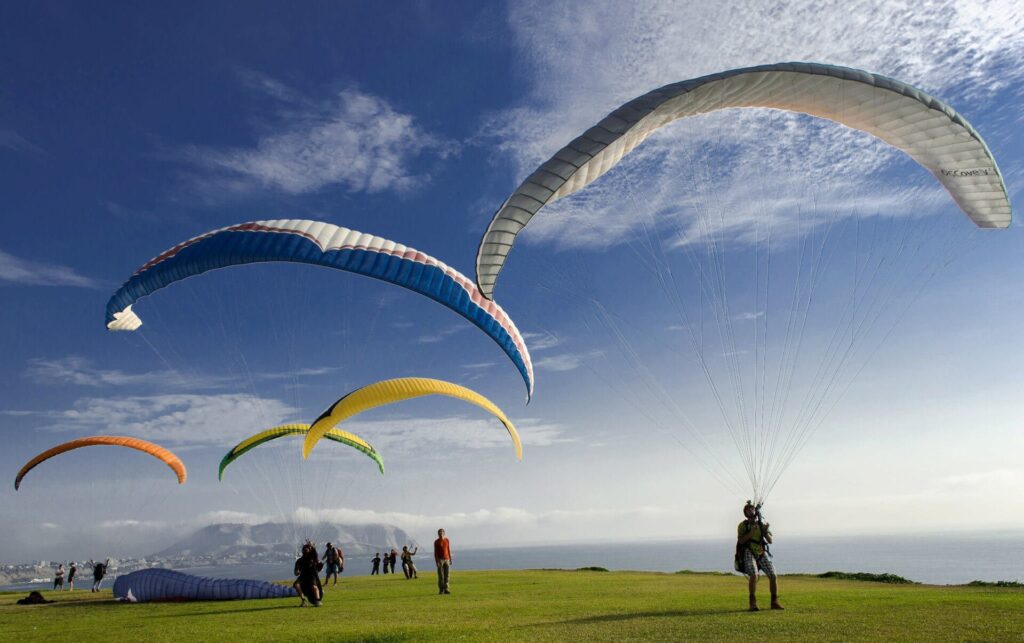
Tandem paragliders launch from the Parapuerto in Parque Raimondi, right next to Parque del Amor, and ride the sea breeze along the cliffs. You don’t need experience: you run a few steps, the pilot does the rest, and you drift past the apartment balconies with the whole bay below. The municipality’s listing gives the price as S/ 300, or US$80, with video included; one operator on the same field charges S/ 260, and operators launching from Magdalena del Mar, farther up the same coast, advertise flights from S/ 180. The flight itself is short, and one operator quotes about 15 minutes in the air, so most of the hour goes to waiting for the wind.
Plan it: daily from 10 a.m. until sunset, weather permitting. Flights are run by three pilots’ associations based at the launch field, where you can book on the spot.
Huaca Pucllana
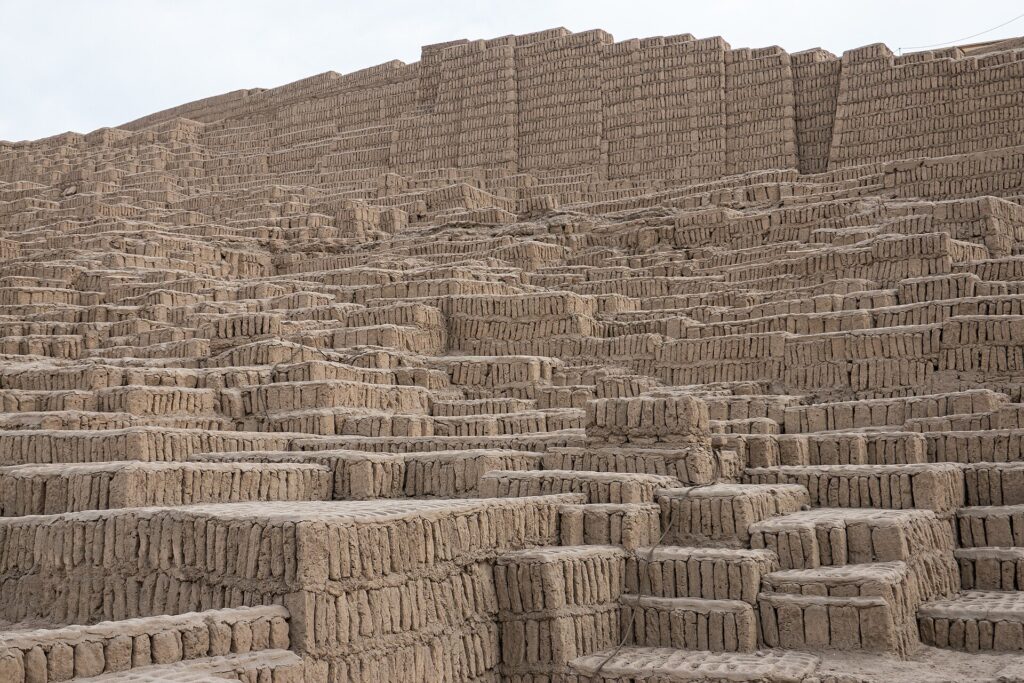
This is the surprise of Miraflores: a stepped adobe pyramid, built by the Lima culture between about AD 450 and 650 according to the Miraflores municipality, rising out of a residential neighborhood less than 20 minutes on foot from Parque Kennedy. The ticket includes a guided walk through the excavated platforms, a room of objects found on site and a garden of native plants and animals. Evening visits show the pyramid lit up.
Plan it: S/ 15 by day, S/ 17 at night. Open Wednesday to Monday, 9 a.m. to 5 p.m.; closed Tuesdays. Evening visits run Wednesday to Sunday from about 6:30 p.m., except on the first Sunday of the month, and need a reservation. Use the Ministry of Culture’s page for information: an old website for the site now shows a betting site. The accessible Pukllaywasi room is designed for visually impaired visitors and children; the ruins themselves are uneven ground.
Parque Kennedy
Miraflores’ central park is a crossroads more than a sight: street performers, craft stalls on many evenings, the Virgen Milagrosa church and a long-standing colony of cats that volunteers feed and put up for adoption. It’s pleasant for half an hour and a useful meeting point. It doesn’t need more of your time than that.
Larcomar
Larcomar is a shopping mall built into the cliff at the end of Avenida Larco, and in PROMPERÚ’s survey it drew more foreign visitors than any museum in the city. The terraces have a fine view of the ocean, and the restaurants are handy on a gray evening. The shops are the same brands you have at home. Walk through at sunset and move on.
LUM, the Place of Memory
On the clifftop at the northern end of Miraflores, the Lugar de la Memoria, la Tolerancia y la Inclusión Social tells the story of the internal armed conflict that killed tens of thousands of Peruvians between 1980 and 2000. It’s sober, well designed and free, and it explains a great deal about the country you’re visiting. Give it at least an hour.
Plan it: free entry with ID, so bring your passport. Open Tuesday to Sunday, 10 a.m. to 6 p.m.; closed Mondays. The entrance is on Bajada San Martín.
Surfing and the Beaches Below
The pebbly beaches at the foot of the cliffs, such as Makaha and Waikiki, are where Lima learns to surf, with waves most of the year. Surf schools run 90-minute lessons that include the board and wetsuit, and you’ll want the wetsuit: the water stays cool even in summer. Before swimming anywhere in Lima, check the beach’s health rating from DIGESA, the Ministry of Health’s environmental agency, which inspects beaches weekly in summer and monthly the rest of the year. The ratings are posted at veranosaludable.minsa.gob.pe, which refused connections from outside Peru when we checked; DIGESA’s own site explains the system. In January 2026, several beaches in Chorrillos and Barranco were rated unfit for bathing.
Barranco: Bridges, Galleries and Old Mansions
South of Miraflores, Barranco began as a seaside resort for Lima’s wealthy families, and its streets are still lined with their pastel-colored mansions. Today it’s the city’s arts and nightlife district, with galleries, murals and bars in old houses. It’s compact enough to walk in an hour, and at its best from late afternoon into the evening.
The Bridge of Sighs and the Bajada de Baños
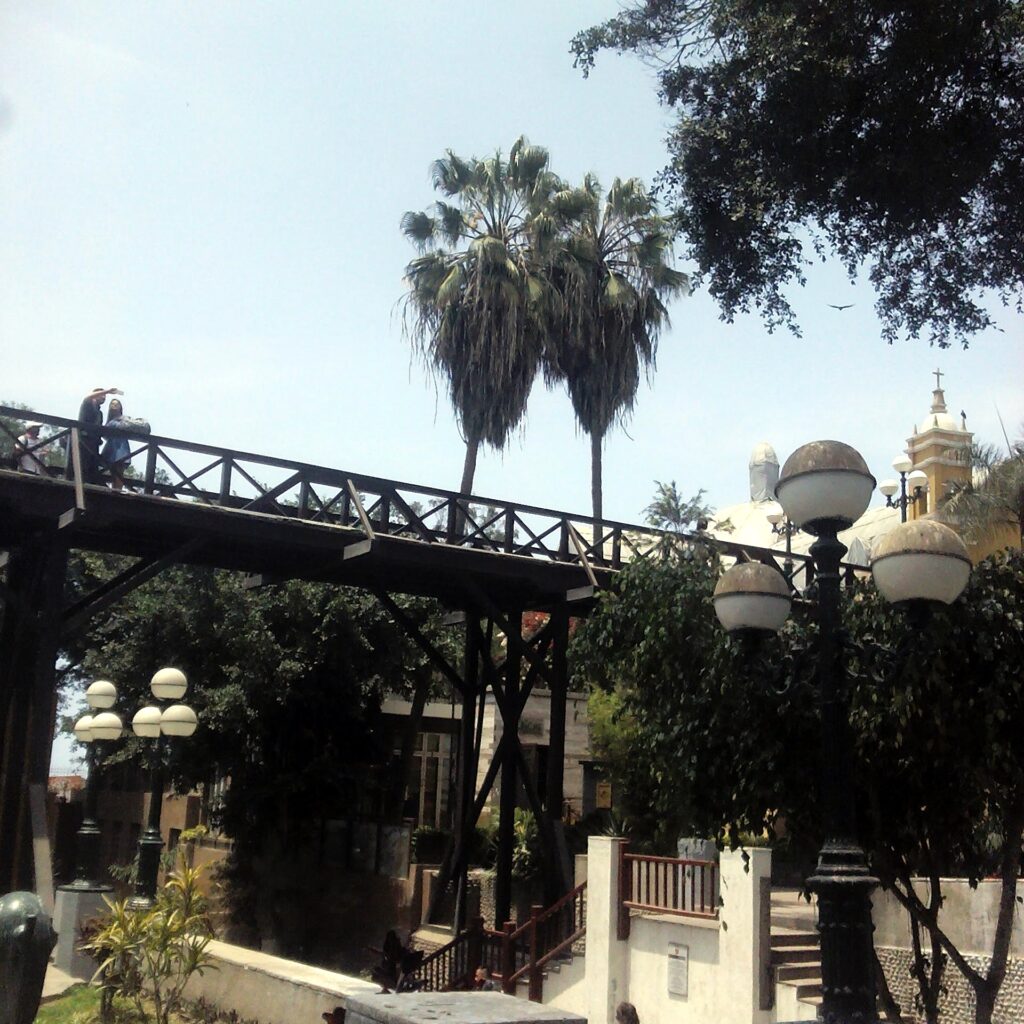
The Puente de los Suspiros is a short wooden footbridge over the Bajada de Baños, a tree-shaded stone path that runs down to the sea between old houses. It’s Barranco’s best-known sight and gets busy on weekend evenings. Walk down the Bajada to the ocean and back up; it’s steep in places and has steps, so it isn’t step-free.
Barranco’s Museums
Barranco has three museums within a few blocks of one another. MAC Lima shows Peruvian and Latin American contemporary art in a modern building in a park on Avenida Grau. Museo Pedro de Osma fills a Republican-era mansion with colonial paintings from the Cusco school, silverwork and furniture, and it lends wheelchairs at the entrance. Next door, MATE, Mario Testino’s photography museum, is often on visitors’ lists, but its website was down when we checked, so confirm it’s open before you go.
Plan it: MAC Lima costs S/ 20 for non-residents and opens Tuesday to Sunday, 10 a.m. to 7 p.m. (half price on the first Sunday of the month). Museo Pedro de Osma costs S/ 35 for foreign adults, plus S/ 10 for an optional guide, and opens Tuesday to Sunday, 10 a.m. to 6 p.m. Both close on Mondays.
Museo Larco and Lima’s Other Big Museums
Museo Larco
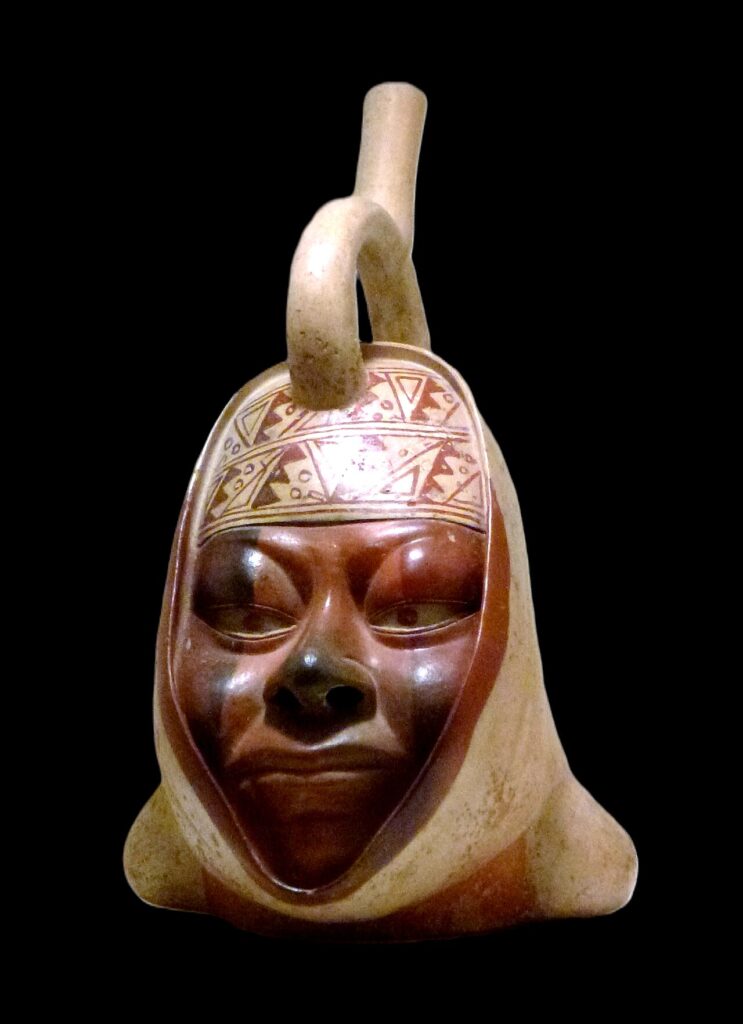
If you see one museum in Lima, make it this one. Set in a white colonial mansion in Pueblo Libre, surrounded by gardens full of bougainvillea, Museo Larco walks you through thousands of years of ancient Peruvian cultures, with the Moche portrait vessels, gold and silver work and textiles as highlights. The explanations come in seven languages, including English. The gallery of erotic pottery, famous in its own right, is included in the ticket, as is a look at the storerooms, where thousands of pots are shelved floor to ceiling. The café-restaurant on the garden terraces is free to enter and good for lunch or an early dinner.
Plan it: S/ 50 at the museum, S/ 45 online; seniors S/ 35. Open every day, public holidays included, 9 a.m. to 7 p.m. (10 a.m. to 6 p.m. on December 24, 25 and 31 and January 1). Ramps reach every exhibition room and the gardens, wheelchairs are lent free on the ground floor and there are accessible restrooms on both levels. The entrance is on Calle Navarra.
MALI, the Lima Art Museum
MALI occupies the Palacio de la Exposición, a 19th-century exhibition hall in a park just south of the historic core. Its collection runs from pre-Columbian textiles through colonial painting to modern Peruvian art, and its temporary exhibitions are often the best in the city. It pairs well with the Magic Water Circuit, a short taxi ride away, on the same afternoon.
Plan it: S/ 40 for foreign adults, S/ 20 for foreign students and over-65s. Open Tuesday to Sunday, 10 a.m. to 6 p.m. (Saturdays until 5 p.m.); closed Mondays. Last entry is 15 minutes before closing. Wheelchairs, ramps, elevators and adapted restrooms are available.
The National Museum in Pueblo Libre, and One That’s Closed
About a kilometer from Larco, on Plaza Bolívar, the Museo Nacional de Arqueología, Antropología e Historia del Perú covers the country’s past from its first cultures to independence. The Ministry of Culture lists it as open, free and wheelchair accessible, Tuesday to Sunday, but also says a full renovation is under way, so check what’s open before you make the trip. Older guides also point to MUNA, the huge new Museo Nacional del Perú in Lurín. It has been closed to visitors since December 2024, with no reopening date.
Eating Is the Main Event
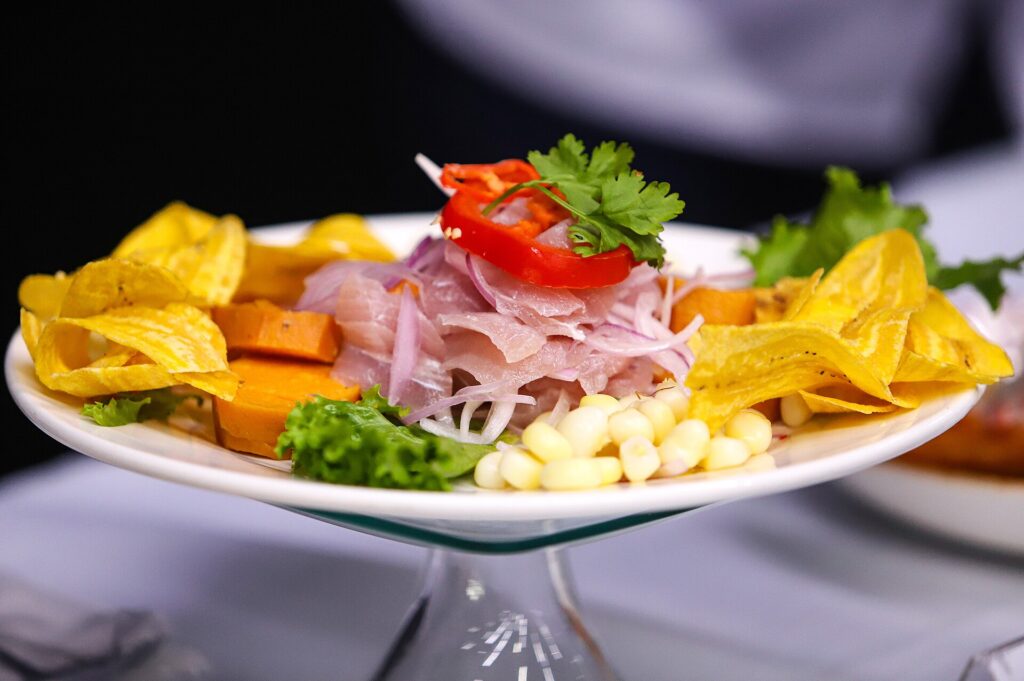
In PROMPERÚ’s 2024 survey, 96% of foreign visitors to Lima did something food-related, more than did any cultural activity. The city’s restaurants have earned it. Central was named The World’s Best Restaurant in 2023 and Maido in 2025, and on November 4, 2026, Lima hosts The World’s 50 Best Restaurants awards, the first time the ceremony has come to Peru. If a tasting menu is part of your plan, book as early as you can, especially around early November.
You don’t need a reservation to eat well, though. Start with ceviche: raw white fish cured for minutes in lime juice with onion and chili, served with sweet potato and large-kernel corn. Limeños eat it at lunch, when the morning’s fish is freshest, and many cevicherías close by late afternoon, so don’t plan it for dinner. Then work outward:
- Chifa, the Chinese-Peruvian cooking of Barrio Chino, from fried rice (arroz chaufa) to wonton soup.
- Anticuchos, grilled skewers of beef heart, a street-food classic in the evening.
- Markets, such as Mercado No. 1 in Surquillo, next to Miraflores, for fruit you won’t recognize and a counter lunch.
- A pisco sour, Peru’s national cocktail, which bars across Miraflores and Barranco take seriously.
Food tours and ceviche cooking classes are popular ways to cover a lot in one go, especially if you have only a day or two.
Lima After Dark
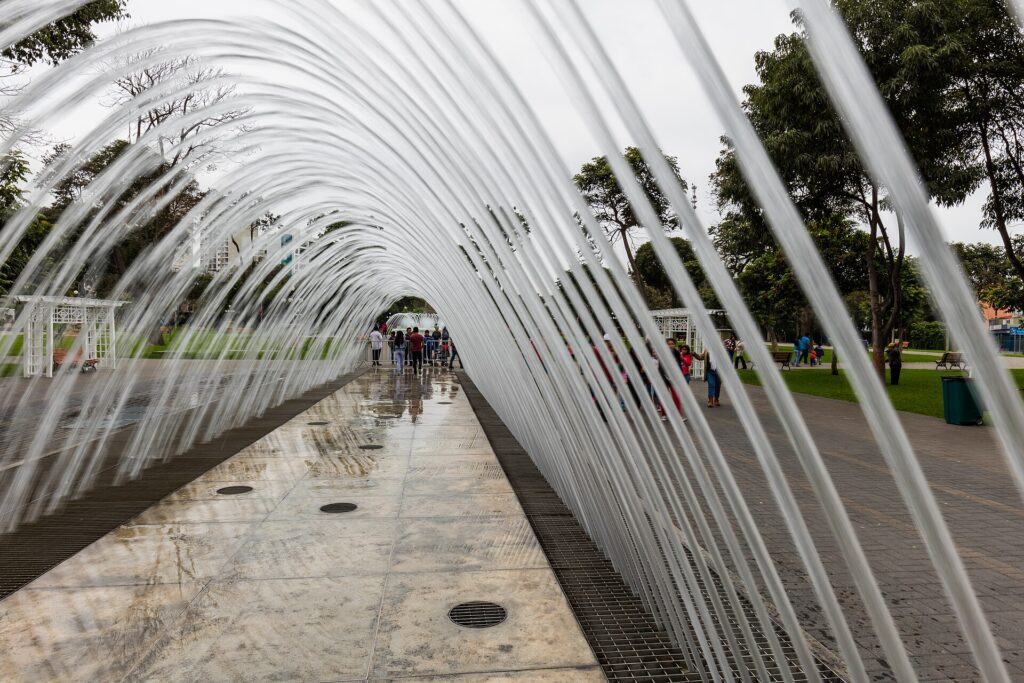
The Magic Water Circuit
The Circuito Mágico del Agua fills Parque de la Reserva, in central Lima, with fountains you walk around, under and, in the case of the water tunnel, through. It sounds like a children’s outing, and families love it, but the evening light-and-music shows on the big fountain are fun at any age. It’s cheap and cheerful. Bring a light jacket, because you may get damp.
Plan it: S/ 7, free under 5 and half price over 65. Open daily, 3 to 10 p.m., with multimedia shows at 7:15, 8:15 and 9:10 p.m. Allow 90 minutes, and arrive by 7 p.m. for the first show.
Barranco at Night
After dark, Barranco’s bars fill up, from pisco bars in old mansions to craft beer and live music. Peñas, where criollo and Afro-Peruvian music gets people dancing, usually get going late. Other good evening options are a night visit to Huaca Pucllana and dinner on the clifftop in Miraflores.
Farther Out: Ruins, Sea Lions and the Port
Pachacamac
For more than a thousand years, pilgrims came to this sanctuary on the coast south of Lima to consult its oracle, and the Incas added a Temple of the Sun on the hill above the sea. The adobe ruins are vast and sandy, and the site museum explains what you’re looking at. It’s 24 km by road south of Miraflores, so allow half a day with the drive.
Plan it: S/ 15, one ticket for the museum and the site. Open Tuesday to Saturday, 9 a.m. to 5 p.m. (tickets until 4:30 p.m.), and Sunday, 9 a.m. to 4 p.m.; closed Mondays. An optional guide costs S/ 50 per group for about 90 minutes. Wheelchairs can be borrowed, but they can’t enter the archaeological zone; free mobility assistance is available Tuesday to Friday by arrangement at the ticket office.
The Palomino Islands
Off the coast of Callao, the Palomino Islands are home to a large colony of sea lions, and boat tours let you swim with them in a wetsuit while seabirds wheel overhead. The islands are part of a national reserve managed by SERNANP, which allows visits only with authorized operators, between 7 a.m. and 2:30 p.m. Tours leave from the pier at Plaza Grau in Callao and take between two and a half and about four hours. One operator lists S/ 160 per adult. Check whether the reserve fee is included, wear the life jacket you’ll be given, and take seasickness pills if you need them, because the sea can be rough.
Callao: Real Felipe, Callao Monumental and La Punta
Lima’s port city has an 18th-century fortress, the Real Felipe, which PROMPERÚ lists as open daily from 9 a.m. to 4 p.m., with guided tours in Spanish. Nearby, Callao Monumental is a block of restored buildings turned into galleries, and La Punta, at the tip of the peninsula, has a seafront promenade past old houses. Most visitors see all three on a tour, which is sensible. If you go on your own, use an app taxi door to door.
The Lomas: Green Hills in Winter
From about June to November, the sea fog that grays out Lima’s winter turns the desert hills around the city briefly green. These fog oases are called lomas. Lomas de Paraíso, on the southern edge of the city, is reachable from María Auxiliadora station on Metro Line 1, and local groups run the trails, so contact them before you go. The Lachay National Reserve, 105 km north (about two hours by road), is the protected showpiece, open daily from 8 a.m. to 3 p.m.
What Can You Skip on a Short Trip?
Every list of things to do in Lima includes some places a first-timer with three days doesn’t need. Our verdicts:
| Often recommended | Verdict | Do this instead |
|---|---|---|
| Shopping at Larcomar | Fine for the view; skip the shops | Sunset in Parque del Amor |
| Parque de las Leyendas zoo | Worth it with young kids (S/ 20); skip it otherwise | Museo Larco |
| Cerro San Cristóbal viewpoint | Views to the coast on a clear day, which the gray months rarely deliver; go only on a sunny day, on an organized tour | The Miraflores clifftops |
| MUNA national museum | Closed since December 2024 | Museo Larco, or the national museum in Pueblo Libre |
| Paracas or Huacachina as a day trip | They’re roughly 250 and 300 km south; that’s a lot of bus for one day | Pachacamac, or an overnight trip south |
When to Go, and What’s Closed When
Lima has two moods. From about December to April it’s summer: sunny, warm and busy on the beaches. From about June to November a low gray cloud covers the coast, with occasional fine drizzle called garúa, and it hardly ever rains properly. Nothing on this list closes for winter, and the lomas are at their best then. Sunset photos are better in summer.
October is the purple month. The processions of the Señor de los Milagros, Lima’s biggest religious festival, fill the center’s streets with crowds in purple robes; in 2026 the processions are on October 3, 18, 19 and 28 and November 1. October 31 is the Día de la Canción Criolla, celebrated with music across the city.
The weekly pattern matters more than the season:
- Closed Mondays: Santo Domingo, MALI, LUM, MAC Lima, Museo Pedro de Osma, Casa de la Literatura, the national museum in Pueblo Libre and Pachacamac.
- Closed Tuesdays: Huaca Pucllana.
- Open every day: Museo Larco, the Cathedral (Sunday from 1 p.m.), San Francisco, Casa de Aliaga and the Magic Water Circuit.
Public holidays shift opening hours, and there are several at the end of 2026: October 8, November 1, December 8, 9 and 25.
Getting Around Safely
Lima is a big city with a real crime problem, and the rules that keep you out of trouble are simple. The UK Foreign Office says street crime, including mugging, is a significant problem in Lima, that express kidnappings happen, and that incidents also occur in Miraflores and Barranco. The US State Department rates Peru at Level 2, “exercise increased caution.” Since late August 2026, a 60-day state of emergency has been in force in Lima and Callao, restricting rights such as freedom of assembly and movement.
In practice:
- Don’t hail taxis on the street. Use an app or a taxi booked by phone, as the UK Foreign Office advises.
- Keep your phone out of sight on busy streets, especially in the center and around the markets.
- Carry a copy of your passport, and the original where a museum asks for ID, such as LUM.
- Use the Metropolitano for the center at rush hour, and keep your bag in front of you, because it gets very crowded.
- Move between areas before dark where you can, and take a taxi rather than walking back late.
Accessibility at a Glance
Few Lima attractions publish good access information. Here’s what the venues themselves say:
| Place | What the venue says |
|---|---|
| Museo Larco | Ramps to all exhibition rooms and gardens, free wheelchair loan, accessible restrooms on both levels |
| MALI | Wheelchairs, ramps, elevators and adapted restrooms |
| Museo Pedro de Osma | Accessible for visitors with reduced mobility; free wheelchair loan |
| National museum, Pueblo Libre | Listed as wheelchair accessible by the Ministry of Culture |
| Pachacamac | Wheelchair loan, but not inside the archaeological zone; free mobility assistance Tuesday to Friday |
| Huaca Pucllana | A sensory room for visually impaired visitors; no step-free information for the ruins |
| Cathedral of Lima | Reduced price and priority entry for holders of Peru’s disability card; no information on physical access |
| Magic Water Circuit | Half price for holders of Peru’s disability card and visitors over 65 |
| Santo Domingo | Tower limited to visitors 18 and older; no other access information |
The Plaza Mayor, Jirón de la Unión and the Miraflores Malecón are the easiest outdoor areas for wheelchair users: flat and paved, though curbs and crowds vary. The Bajada de Baños in Barranco and the San Francisco catacombs are the hardest.
Things to Do in Lima FAQ
How many days do you need in Lima?
Two full days cover the essentials: the historic center on one, and Miraflores, Barranco and Museo Larco on the other. A third day adds Pachacamac, the Palomino Islands or a slower pace with more museums and meals. That matches how visitors actually travel: PROMPERÚ’s 2024 survey put the median stay at three nights, often before or after Cusco.
Is Lima worth visiting, or is it just a stopover?
It’s worth at least two days. Lima has the country’s best museums for understanding ancient Peru, a colonial center on UNESCO’s World Heritage List and some of the best food in the world, with the world’s top-ranked restaurant in both 2023 and 2025. Visitors who treat it as an airport transfer to Cusco miss much of what makes Peru make sense.
What can you do in Lima for free?
Plenty. The Plaza Mayor and the changing of the guard, Plaza San Martín, the Casa de la Literatura, the Miraflores clifftops and Parque del Amor, Barranco’s Bridge of Sighs and LUM all cost nothing. The national museum in Pueblo Libre is listed as free too. Add a cheap Metropolitano ride and a S/ 7 evening at the Magic Water Circuit, and you have a full day for very little.
Do you need a tour to see Lima?
Not for most of it. The historic center, Miraflores and Barranco are easy to see on your own, and the San Francisco visit comes with a guide anyway. You do need an official guide for Casa de Aliaga, an authorized operator for the Palomino Islands and a taxi or tour to reach Pachacamac. If you have only one day, a food tour is the tour most worth considering.
Is it safe to walk around Lima’s historic center?
In daylight, on the main squares and pedestrian streets, most visitors have no problems, but it’s a crowded area where pickpocketing and phone snatching happen, so keep valuables out of sight. Take an app taxi rather than walking there after dark, and if police have fenced off streets for a protest, come back another day.
Can you see Lima on a layover?
With a long layover, yes, if you’re realistic about traffic. The official Airport Express Lima bus costs S/ 20 per person to stops in Miraflores, where a clifftop walk, Huaca Pucllana and a ceviche lunch fit into a few hours. Leave generous time to get back through traffic and airport security. The historic center and Larco are easier to combine with an overnight stay.
Sources and How We Checked
Prices, hours and closures in this guide were checked on September 24, 2026, against the venues, agencies and data sources listed below. The guide is compiled from them, not from other travel lists, and it doesn’t claim first-hand visits. Both maps are our own, drawn from OpenStreetMap data, and the drive times are estimates made by applying TomTom’s measured averages to route distances.
- PROMPERÚ: Profile of the foreign tourist who visits Lima, 2024; Callao visitor guide; Real Felipe
- Ministry of Culture of Peru: Huaca Pucllana site museum; Pachacamac visitor information; LUM; national museum in Pueblo Libre; MUNA status; San Francisco convent listing
- Municipality of Miraflores: Huaca Pucllana; Parapuerto paragliding; Malecón and bike lanes
- Historic center venues: Cathedral of Lima; San Francisco convent and catacombs; Santo Domingo convent; Casa de Aliaga; Casa de la Literatura Peruana; Circuito Mágico del Agua
- Museums: Museo Larco; MALI; MAC Lima; Museo Pedro de Osma; Parque de las Leyendas
- SERNANP: Palomino Islands sector; Lachay National Reserve
- Tour operator prices: Tour Marino Isla Palomino; Infinity paragliding; Condor Xtreme
- Transport and traffic: TomTom Traffic Index, Lima; Lima Airport Partners, airport buses; Metropolitano fares (Infobae); OpenStreetMap routing and map data
- Safety and news: UK Foreign Office, Peru safety and security; US State Department, Peru travel advisory; Andina, state of emergency in Lima and Callao; Infobae, June 2026 historic center closure; Infobae, MUNA closure
- Events and food: ACI Prensa, Señor de los Milagros 2026 processions; The World’s 50 Best Restaurants 2026 in Lima; DIGESA, Verano Saludable 2026 beach ratings
Lima Tourism Guide is an independent publication. We are not affiliated with PROMPERÚ, the Municipality of Lima or any attraction listed here, and no one paid to be included.
Photo Credits
- Miraflores from above: photo by Alec Gamoff, Wikimedia Commons (CC BY 2.0)
- Cathedral of Lima: photo by Wasiwatana, Wikimedia Commons (CC BY-SA 4.0)
- Paragliders in Miraflores: photo by Andrearubin, Wikimedia Commons (CC BY 3.0)
- Huaca Pucllana: photo by PsamatheM, Wikimedia Commons (CC BY-SA 4.0)
- Puente de los Suspiros, Barranco: photo by Herwarth Morales, Wikimedia Commons (CC BY-SA 4.0)
- Moche portrait vessel, Museo Larco: photo by Pierre André Leclercq, Wikimedia Commons (public domain)
- Ceviche: photo by GORE Callao, Wikimedia Commons (public domain)
- Magic Water Circuit, Parque de la Reserva: photo by Diego Delso, Wikimedia Commons (CC BY-SA 4.0)
- Maps of Lima’s main sights and the historic center walking route: Lima Tourism Guide, drawn from map data © OpenStreetMap contributors (ODbL)