A good Lima, Peru itinerary for first-time visitors gives each day one part of the city, because the traffic between the parts eats any time you don’t protect. Spend one day on foot in the historic center, reaching the Plaza Mayor for the noon changing of the guard. Give a second to Museo Larco in the morning and the Miraflores clifftops in the afternoon, and a third to either the Pachacamac ruins and Barranco or a boat out to the sea lions of the Palomino Islands. Three days covers the essentials without a rush. Two is the least we’d suggest, and one works only if you accept a lot of time in taxis.
This plan is for travelers seeing Lima for the first time, usually before or after Cusco, with one to five days to spend. The caveat that matters most is traffic: TomTom’s 2025 index puts the average 10 km drive in metropolitan Lima at nearly 35 minutes, and over 51 minutes in the evening rush. So every day below stays in one area, with measured drive times and the day each stop closes. Opening hours, prices and closures were checked on September 24, 2026, against the venues’, operators’ and agencies’ own websites.
On this page: At a glance · How many days · Five planning rules · Where to stay · The day plans · 1 to 5 days · What’s closed when · Costs · Where to eat · Tours or on your own · Flights · Season, kids and mobility · Disruptions · FAQ
Lima Itinerary at a Glance
Entry fees are the standard foreign-adult prices, in soles, for the core stops in each plan, as checked on September 24, 2026. The San Francisco catacombs come on top: the convent doesn’t publish its price online, so you pay at the door. Taxi time is what each plan spends in cars at TomTom’s 2025 citywide average, before any rush-hour penalty.
| Trip length | What fits | Core entry fees | Time in taxis | Verdict |
|---|---|---|---|---|
| 1 day | Museo Larco at 9 a.m., the historic center at noon, the Miraflores clifftops at sunset | S/ 75 to S/ 80 | About 1.5 hours | Possible, but you only sample each area |
| 2 days | Day A (historic center) and Day B (Larco and Miraflores) | S/ 112 to S/ 117 | About 1 hour a day | The shortest trip we’d call a proper first visit |
| 3 days | Add Day C (Pachacamac and Barranco) or Day D (Palomino Islands and Callao) | S/ 162 to S/ 167 with Day C; S/ 272 to S/ 277 with Day D | About 2.5 hours on the Pachacamac day | The sweet spot, and the typical stay |
| 4 days | Days A to D | S/ 322 to S/ 327 | About 2 hours on the Callao day | Worth it if you like boats, birds and ruins |
| 5 days | Days A to D, plus Caral, Lachay or a food day | S/ 333 to S/ 338 with Caral, plus its required guide | A full day on the road for Caral | Only if Lima is the trip, not the stopover |
How Many Days Do You Need in Lima?
Three, if you can spare them. That’s also what most visitors give the city: PROMPERÚ’s 2024 survey of foreign tourists in Lima, built on 5,268 interviews, found a median stay of three nights and an average of five. The median is the number to plan with, since a minority of long stays drags the average up.
Here is how the days divide. The sights a first-timer needs fall into three clusters: the colonial historic center; Pueblo Libre, home to Museo Larco; and the clifftop districts of Miraflores and Barranco. Two half-day outings sit farther out, the Pachacamac sanctuary to the south and the port of Callao, with its boats to the Palomino Islands, to the west. A day per cluster plus one outing makes three days, and each extra day buys either another outing or a slower pace.
Two days works if you’re disciplined: the center one day, Larco and Miraflores the next, and dinner in Barranco on one of the two nights. One day works as a sampler, and a layover works only if it’s a long one; the math for both is further down. Five days is generous for a first visit unless you want the long trip north to the Sacred City of Caral, or you came mainly to eat.
Our guide to the best things to do in Lima describes each sight in detail. This page does a different job: it fits those sights into days that work around Lima’s traffic, its closing days and its lunch hour.
Five Rules That Shape Every Lima Itinerary
1. One area per day, because of the traffic
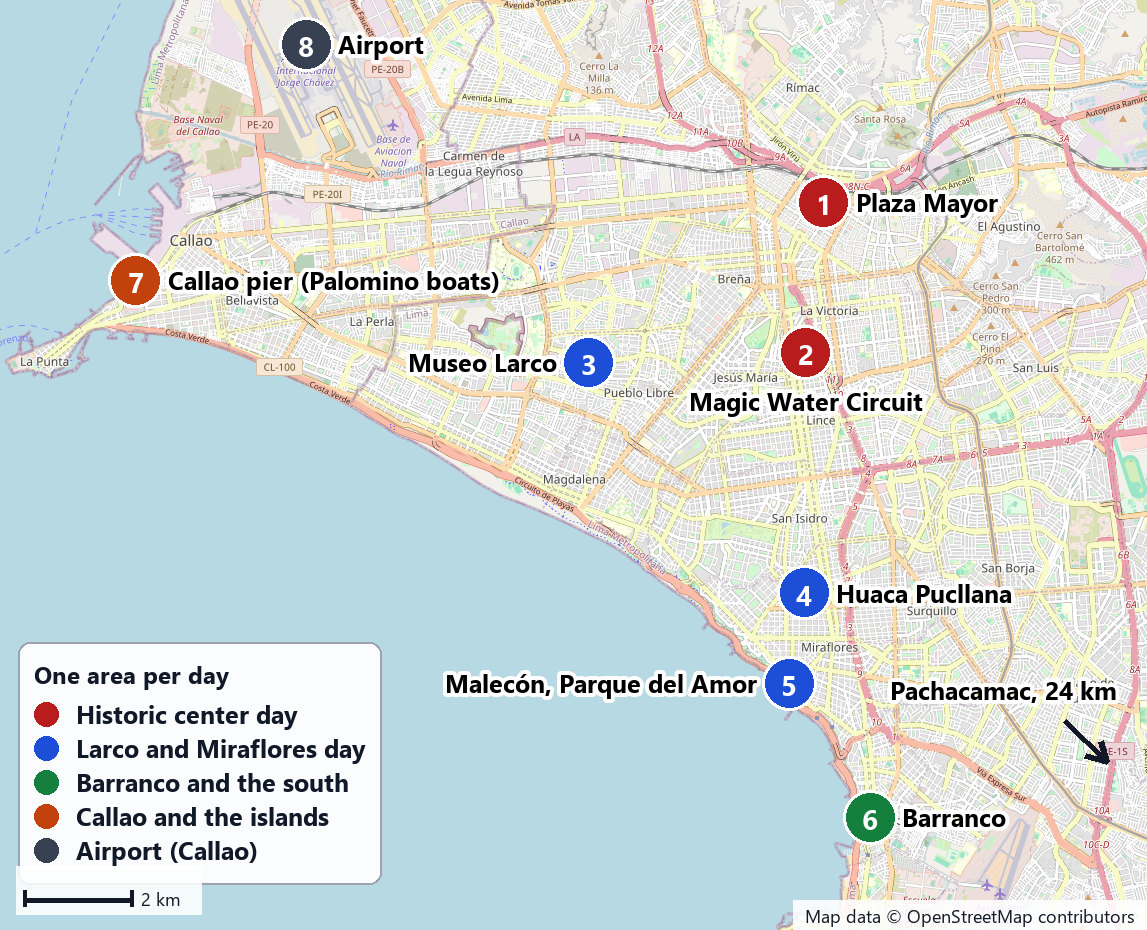
Nothing a first-timer needs is far apart. The Plaza Mayor is 9.7 km by road from Parque Kennedy in Miraflores, and Museo Larco sits off to the side between them. What wears you down is the time those kilometers take. We measured road distances with OpenStreetMap routing and applied TomTom’s 2025 averages for metropolitan Lima: 34 minutes 53 seconds per 10 km across the whole day, 43 minutes in the morning rush and 51 minutes 17 seconds in the evening rush.
| Route | Road distance | Typical drive | Evening rush |
|---|---|---|---|
| Parque Kennedy (Miraflores) to Barranco’s Bridge of Sighs | 4.5 km | About 16 minutes | About 23 minutes |
| Parque Kennedy to the Magic Water Circuit | 7.2 km | About 25 minutes | About 37 minutes |
| Museo Larco to the Plaza Mayor | 7.3 km | About 25 minutes | About 37 minutes |
| Plaza Mayor to Parque Kennedy | 9.7 km | About 34 minutes | About 50 minutes |
| Parque Kennedy to Museo Larco | 9.9 km | About 35 minutes | About 51 minutes |
| Airport (new terminal) to the Plaza Mayor | 15.3 km | About 53 minutes | About 1 hour 20 minutes |
| Parque Kennedy to the Callao pier at Plaza Grau | 17.2 km | About 1 hour | About 1 hour 30 minutes |
| Pachacamac to Barranco | 19.6 km | About 1 hour 10 minutes | About 1 hour 40 minutes |
| Airport (new terminal) to Parque Kennedy | 20.9 km | About 1 hour 15 minutes | About 1 hour 45 minutes |
| Parque Kennedy to Pachacamac | 24.0 km | About 1 hour 25 minutes | About 2 hours |
Treat those as planning numbers, not promises. The long runs to Pachacamac and the airport use expressways that can move faster at quiet hours, and a march, a procession or a fender-bender can double any of them. The pattern holds, though: two areas in a day is comfortable, three makes it a taxi day, and the same crossing in the evening rush takes about half as long again as it does at an average hour.
2. Mondays close most museums, and Tuesdays close Huaca Pucllana
Monday is the day to plan around. MALI, Santo Domingo, the Casa de la Literatura, LUM, the national museum in Pueblo Libre, Museo Pedro de Osma, MAC Lima and the Pachacamac sanctuary all close. Museo Larco, the Cathedral, San Francisco, Casa de Aliaga and Huaca Pucllana stay open, which makes Day B, Larco and Miraflores, the natural Monday. Huaca Pucllana takes Tuesday off instead, so don’t put Day B on a Tuesday without the swap below.
3. Be at the Plaza Mayor before noon
The changing of the guard at the Government Palace takes place at noon, carried out by the cavalry regiment that serves as the presidential escort, and it’s free to watch from the railings. Build the center day so you’re on the square by about 11:45. The ceremony depends on the plaza being open, though. During protests and big security operations the police close the perimeter, as they did from June 19 to 22, 2026.
4. Lunch is the main meal
Limeños eat their big meal in the early afternoon, and many cevicherías close by late afternoon, because ceviche is a lunch dish made with the morning’s fish. So put the ceviche at lunch and plan dinner around something else: chifa, a criollo tavern or a tasting menu. Every plan below keeps a proper lunch slot, usually later than you’d eat at home.
5. Sunset comes early, and the sky is often gray
Lima sits 12 degrees south of the equator, so the length of the day barely changes. By our calculation with NOAA’s solar equations, the sun sets at about 6:40 p.m. in mid-January, 6:04 p.m. from mid-August to mid-October and 5:51 p.m. in May and June. From about June to November a low marine cloud usually covers the coast, bringing a fine drizzle called garúa rather than real rain; SENAMHI, the national weather service, puts Lima’s rainfall at under 15 mm a year. A clifftop sunset is a summer plan. In the gray months the sunset is mostly a change in the shade of gray, so spend the late afternoon in a museum and walk the malecón anyway.
Where Should You Base Yourself?
Most first-time visitors sleep in Miraflores or Barranco, and these plans assume you do. The clifftop walk, Huaca Pucllana and Barranco’s bars are on foot or a short ride away, and the official Airport Express Lima bus stops at four points in Miraflores. The trade-off is the 9.7 km run to the historic center on Day A.
Staying in the historic center flips that. The colonial sights are outside your door, Museo Larco is 7.3 km away and the airport is closer. But the evening plans on this page, the clifftops at sunset and Barranco’s bars, become a 10 km ride, and when protests or security operations close the streets around the Plaza Mayor, you’re inside the cordon. San Isidro, between the two, shortens the run to both. Whichever you choose, grouping each day by area matters more than where the hotel is.
The Day Plans: Five Lima Days, Timed
Each plan below covers one area, timed from a hotel in Miraflores, with a lunch stop, the day it doesn’t work and a swap for that day. Mix them to fit your trip length; the section after this one shows the combinations. The drive estimates come from the table above, and the times assume you move by taxi app between areas.
Day A: The Historic Center on Foot
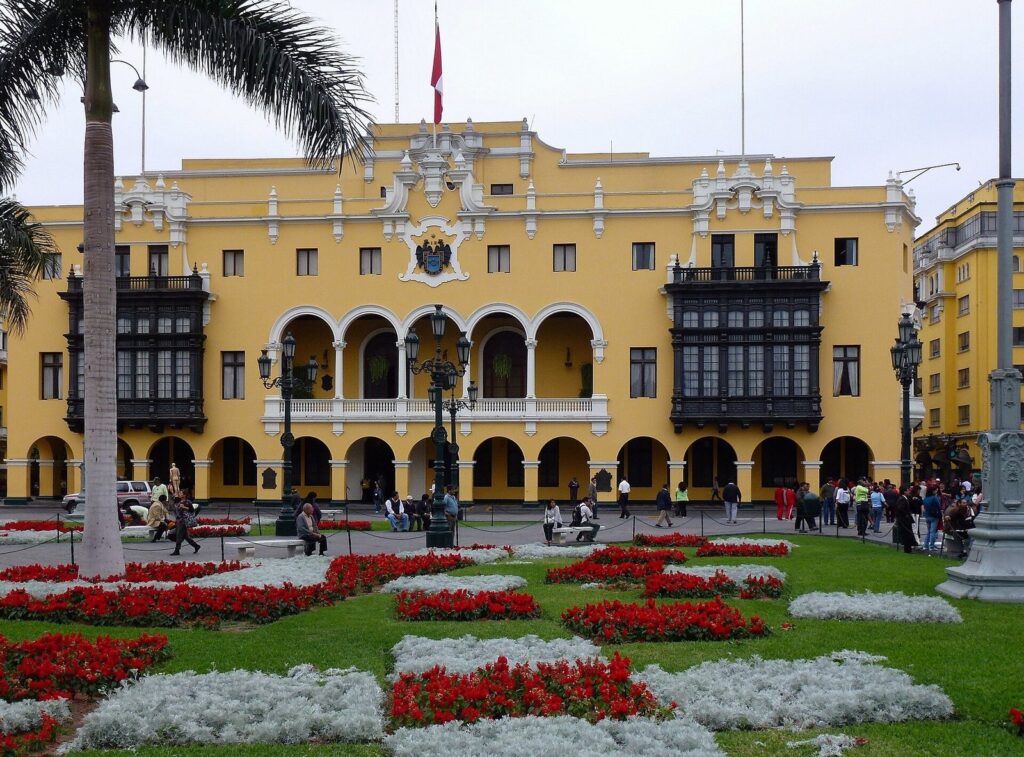
The historic center is a walking day, and it runs in the order the stops close. Start at about 9:30, when the Cathedral has been open for half an hour on a weekday and the palace guard is still more than two hours off. The whole route, from Plaza San Martín to Chinatown, is under 3 km on foot.
| Time | Stop | Why then |
|---|---|---|
| 9:30 a.m. | Plaza San Martín, then down the pedestrian Jirón de la Unión to the Plaza Mayor (950 m, about 13 minutes) | The classic approach to the colonial core |
| 10:00 a.m. | Cathedral of Lima, S/ 30 (about 1 hour) | Opens at 9 a.m. on weekdays, 10 a.m. on Saturdays and only at 1 p.m. on Sundays |
| 11:10 a.m. | Santo Domingo convent, S/ 15 with a guided visit and the tower (45 minutes) | It shuts from 1 to 2 p.m. and all day Monday |
| 11:45 a.m. | The Government Palace railings on the Plaza Mayor | The changing of the guard starts at noon |
| 12:35 p.m. | Casa de la Literatura Peruana, in the old Desamparados railway station (free, 20 minutes) | A quick look at the building; closed Mondays |
| 1:00 p.m. | San Francisco convent and catacombs, guided (about 1 hour; pay at the door) | Open daily, with Spanish- and English-speaking guides |
| 2:15 p.m. | Late lunch in Chinatown, around Calle Capón (about 760 m on foot) | Chifa for lunch, next to the Mercado Central |
| 3:45 p.m. | Taxi to MALI, the Lima Art Museum, in Parque de la Exposición (about 2 hours) | Open until 6 p.m. (5 p.m. on Saturdays); closed Mondays |
| 7:15 p.m. | Magic Water Circuit in Parque de la Reserva, S/ 7 | Water, light and laser shows at 7:15, 8:15 and 9:10 p.m. |
That’s a long day, and you can trim it at either end. To save your feet, skip MALI and take a taxi back to Miraflores straight after lunch, before the evening rush builds. If you still have energy after dark, the Magic Water Circuit sits on the way back south, 7.2 km from Parque Kennedy, so it makes a natural last stop, with a quick dinner between MALI’s closing time and the first show.
Monday swap: Santo Domingo, the Casa de la Literatura and MALI are all closed. Book Casa de Aliaga instead, the colonial family mansion on Jirón de la Unión beside the Plaza Mayor, open daily from 10 a.m. to 4 p.m. It has no guides of its own, so you’ll need to bring a licensed guide, and entry is S/ 35.
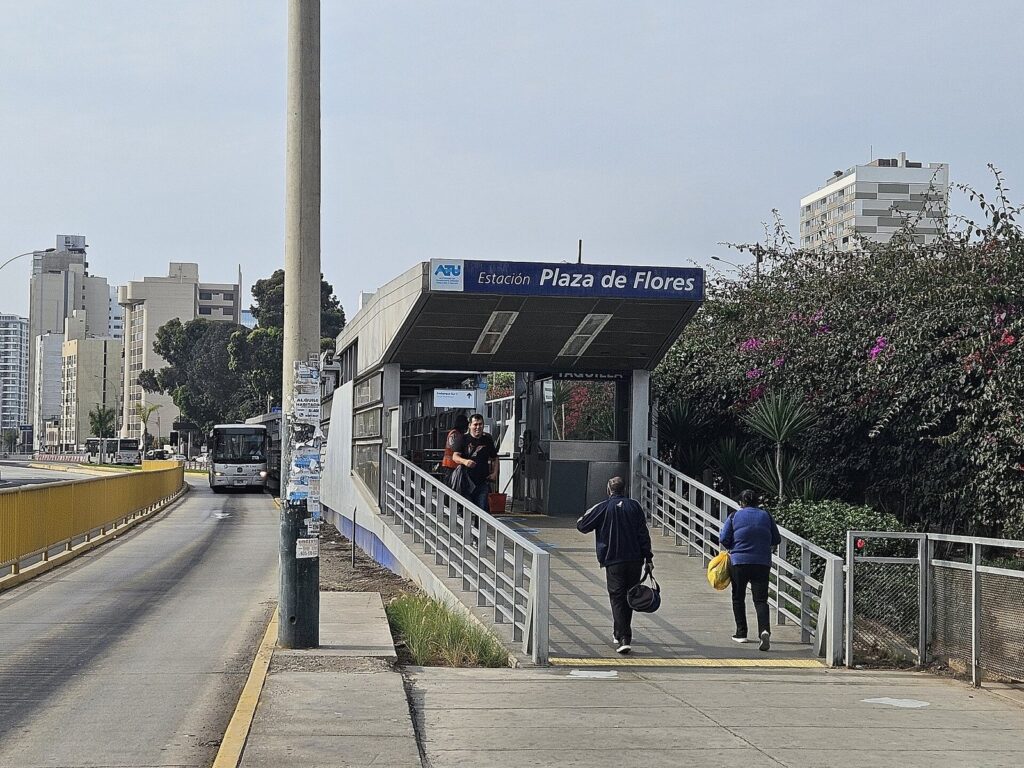
Plan it: Core entry fees come to S/ 52 (Cathedral, Santo Domingo and the Magic Water Circuit) plus San Francisco’s door price, or S/ 92 with MALI. Get there by app taxi (9.7 km, about 34 minutes) or on the Metropolitano: Route C, the all-stops service, runs from Ricardo Palma and Benavides stations in Miraflores to Colmena and Jirón de la Unión stations in the center. Check the route map at the station, since services change. The evening before, look at the local news for marches or closures around the Plaza Mayor.
Day B: Museo Larco, Then the Miraflores Clifftops
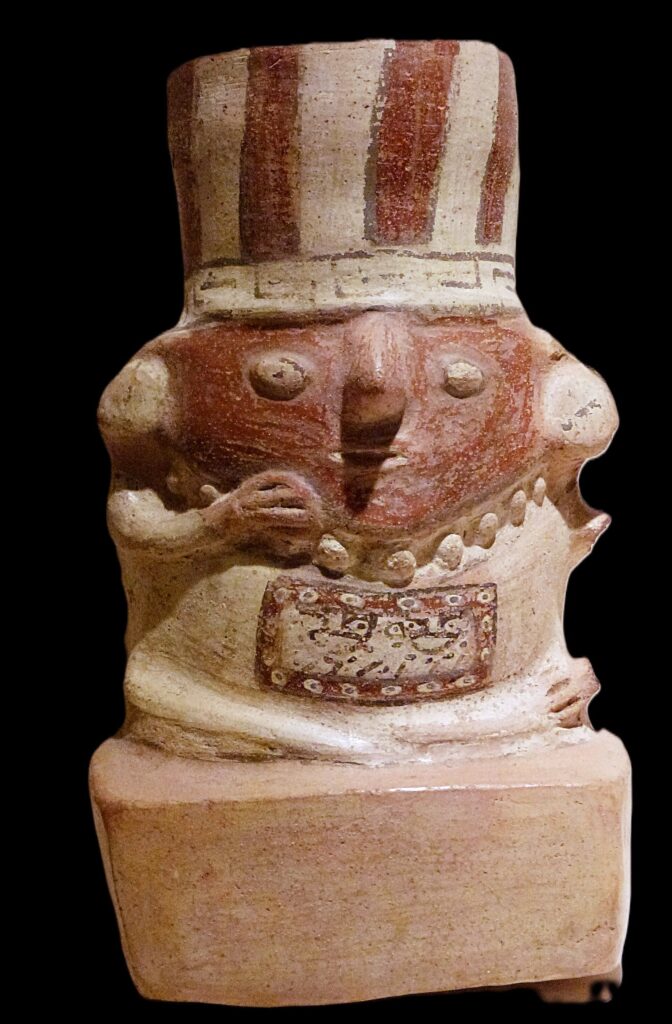
This is the easiest day to get right and the best one for a Monday. Museo Larco opens at 9 a.m. every day of the year, public holidays included, so start there, eat lunch in Pueblo Libre and drop down to the coast for the afternoon.
| Time | Stop | Why then |
|---|---|---|
| 8:25 a.m. | Taxi from Miraflores to Museo Larco (9.9 km, about 35 minutes) | Arrive for the 9 a.m. opening |
| 9:00 a.m. | Museo Larco, Pueblo Libre: S/ 45 online or S/ 50 at the door (2 to 3 hours) | Open daily until 7 p.m.; gallery texts in seven languages, including English |
| 11:45 a.m. | Optional: walk 1.5 km (about 19 minutes) to the national museum of archaeology, anthropology and history on Plaza Bolívar | Free entry; closed Mondays |
| 12:45 p.m. | Lunch at the Museo Larco café-restaurant, or at Antigua Taberna Queirolo, 1.4 km from the museum | The café needs no museum ticket; Queirolo’s story goes back to 1880 |
| 2:00 p.m. | Taxi to Miraflores (9.9 km, about 35 minutes) | You’re off the road well before the evening rush |
| 2:45 p.m. | Huaca Pucllana, S/ 15 with the guided walk included (about 1 hour) | Open 9 a.m. to 5 p.m.; closed Tuesdays |
| 4:15 p.m. | Walk to Parque Kennedy (1.9 km), then along the malecón to Parque del Amor (1.0 km) | Paragliders fly from 10 a.m. to sunset when the wind allows |
| Sunset | Larcomar, 1.0 km farther along the clifftop | Between about 5:50 and 6:40 p.m., depending on the month |
| 7:30 p.m. | Dinner in Miraflores, or at the restaurant inside the Huaca Pucllana site | Book the restaurant; it closes at 10 p.m. (8 p.m. on Sundays) |
The walk from Huaca Pucllana through Parque Kennedy to Larcomar is 3.9 km, about 54 minutes at an easy pace. The Miraflores clifftop path runs 5.4 km in all, from the San Isidro boundary to Barranco, so if the light is good you can keep walking south instead of stopping at Larcomar.
Tuesday swap: Huaca Pucllana is closed. Replace it with LUM, the Place of Memory, a free museum in Miraflores about the internal conflict of 1980 to 2000 (Tuesday to Sunday, 10 a.m. to 6 p.m.), or with Huaca Huallamarca, a smaller adobe pyramid in San Isidro that costs S/ 5 and opens Tuesday to Saturday. If you’d like Pucllana after dark on another day, its night visits run Wednesday to Sunday by reservation, for S/ 17.
Plan it: Entry fees are S/ 60 to S/ 65. A tandem paraglider flight off the cliffs adds S/ 260 to S/ 300 from the Miraflores Parapuerto; Condor Xtreme lists S/ 180 for flights from Magdalena del Mar, farther north. Flights depend on the wind, so if you want to fly, try early in the trip and keep a second afternoon free in case the first attempt is grounded.
Day C: Pachacamac and Barranco
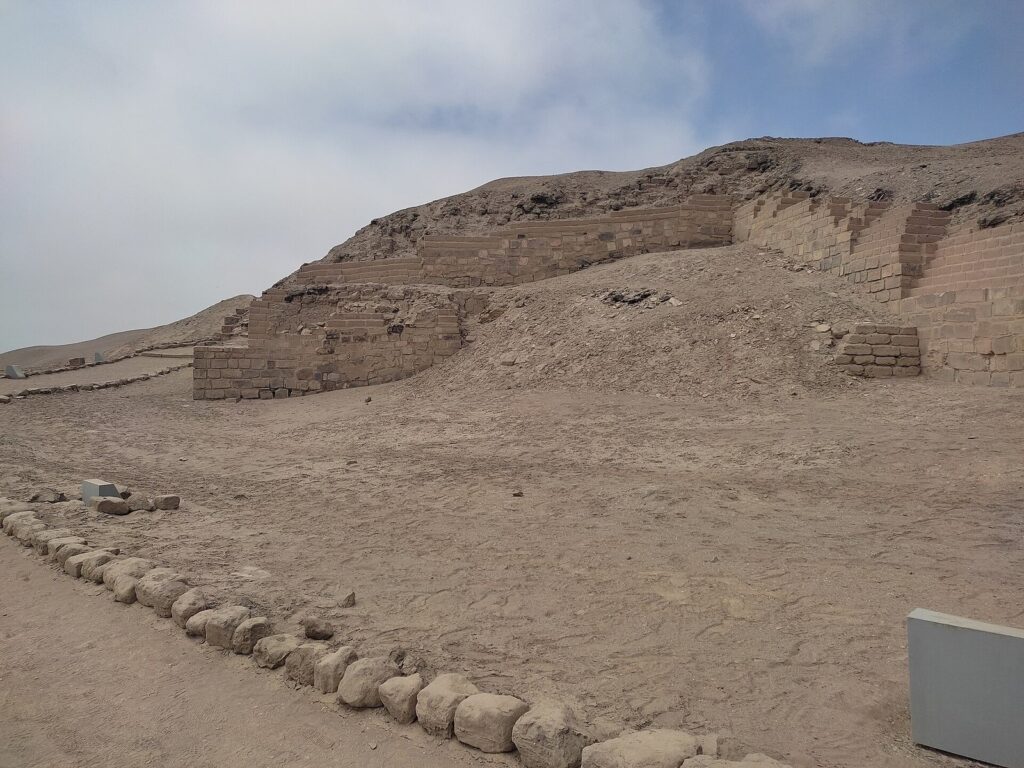
Pachacamac shows what this coast was before Lima existed: a pre-Hispanic sanctuary of adobe temples and pyramids that drew pilgrims for centuries, with an Inca Temple of the Sun on top. It’s a morning trip. The ticket office closes at 4:30 p.m. (3:30 p.m. on Sundays), and you want the drive home done before the evening rush. Barranco is on the way back, so the afternoon takes care of itself.
| Time | Stop | Why then |
|---|---|---|
| 8:15 a.m. | Leave Miraflores for Pachacamac (24 km, about 1 hour 25 minutes at the city average) | Arrive soon after the 9 a.m. opening |
| 9:40 a.m. | Site museum, then the circuit through the sanctuary, S/ 15 (about 2.5 hours) | One ticket covers both; an optional guide costs S/ 50 per group for about 1.5 hours |
| 12:30 p.m. | Drive to Barranco (19.6 km, about 1 hour 10 minutes) | Lunch lands at the Limeño hour |
| 1:45 p.m. | Late lunch in Barranco | Ceviche while the cevicherías are still serving |
| 3:15 p.m. | Museo Pedro de Osma, S/ 35, for colonial art, or MAC Lima, S/ 20, for contemporary art | Both closed Mondays; Pedro de Osma closes at 6 p.m., MAC at 7 p.m. |
| 5:15 p.m. | The Bridge of Sighs, then down the Bajada de Baños toward the sea (725 m from Pedro de Osma, plus 193 m) | Free, and best in the last of the light |
| Evening | Dinner and a drink in Barranco | Parque Kennedy is 4.5 km away, about 16 minutes by car |
Monday swap: Pachacamac, Pedro de Osma and MAC all close on Mondays. Do Day B or Day D instead, and see Barranco’s streets on a Monday evening; the Bridge of Sighs never closes.
Plan it: Entry fees are S/ 50 with Pedro de Osma, or S/ 35 with MAC. Pachacamac is the one stop in these plans where a driver for the morning, or a small-group tour, can beat app taxis. The sanctuary is on the old Panamericana Sur in Lurín, well outside the districts visitors stay in, so arrange your ride back before you go in. It lends wheelchairs for free, and from Tuesday to Friday a free service takes visitors with reduced mobility around the circuit; book it at the ticket office.
Day D: Callao and the Palomino Islands
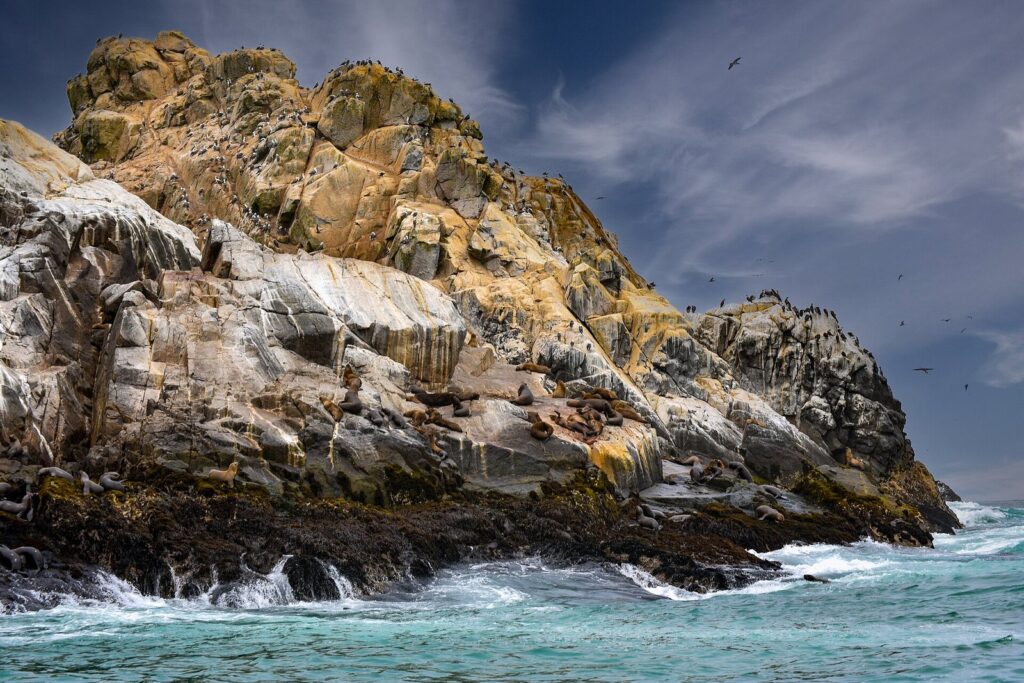
If you want one outing that feels nothing like the rest of the trip, take a boat from Callao to the Palomino Islands, where sea lions haul out on the rocks below the seabird colonies and the tours let you into the water near them. The islets belong to a national reserve, so only operators authorized by SERNANP, Peru’s protected-areas service, can take you there.
| Time | Stop | Why then |
|---|---|---|
| 8:30 a.m. | Leave Miraflores for the pier at Plaza Grau, Callao (17.2 km, about 1 hour) | Operators ask you to arrive 30 minutes early |
| 10:00 a.m. | Boat to the Palomino Islands with Tour Marino, adults S/ 160, life jacket included | About 30 minutes in the water with the sea lions |
| 2:00 p.m. | Back at the pier; late lunch on the seafront in La Punta | La Punta’s malecón is lined with old republican-era houses |
| 3:30 p.m. | Callao Monumental, the port’s neighborhood of galleries and exhibitions | PROMPERÚ pitches it as a cultural afternoon |
| 4:30 p.m. | Back to Miraflores | Leaving later adds about half an hour in the evening rush |
The Real Felipe fortress, the colonial fort by the port, is Callao’s other big sight, but its guided visit takes 2 hours 30 minutes, in Spanish, and it closes at 4 p.m., so it doesn’t fit after a morning on the boat. Give it a morning on a no-boat day instead, and phone ahead, because it sometimes closes for maintenance.
Plan it: The boat is S/ 160 for adults and S/ 130 for children aged 4 to 12 with Tour Marino, which sails daily; faster speedboat tours of about 2.5 hours also run, and some operators ask for your passport details when you book. Sea conditions can delay or cancel sailings, so put this day early in the trip to leave room for a second try. Pack swimwear and a towel: operators supply the life jacket and, on some tours, a wetsuit. Because the boats run every day, Day D makes a good Monday plan.
Day E: One Long Trip Out of the City
With a fifth day, leave Lima entirely. The big one is the Sacred City of Caral, the archaeological site 184 km up the Panamericana Norte to the Supe roundabout and then inland along the Supe valley. It opens daily from 9 a.m. to 5 p.m. with last entry at 4 p.m. and costs S/ 11, and every visit walks the roughly 90-minute circuit with one of the site’s heritage guides, hired at the ticket office. Expect a full day with a dawn start.
Closer, greener options depend on the season. The lomas, coastal hills that turn green in the winter mist, are at their best from about July to October. The Lachay National Reserve is 105 km north, about two hours by road; it opens from 8 a.m. to 3 p.m., costs S/ 30 for foreign visitors, and you can visit without an operator. Lomas de Paraíso lies inside the metropolitan area, in Villa María del Triunfo, but contact the local conservation group first to check the trail’s condition and its hours.
Putting the Days Together: 1 to 5 Days
The order matters almost as much as the choice, because of the closing days. Use this table to slot the plans into your dates, then read the notes for your trip length.
| Trip | Order | If the trip includes a Monday | If the trip includes a Tuesday |
|---|---|---|---|
| 1 day | Larco at 9 a.m., the center from 11:30, the Miraflores clifftops at sunset | Works: Larco, the Cathedral and San Francisco are open | Works: this plan skips Huaca Pucllana |
| 2 days | Day A, then Day B | Put Day B on the Monday | Put Day A on the Tuesday |
| 3 days | Day A, Day B, then Day C or Day D | Day B or Day D on the Monday | Day A or Day C on the Tuesday |
| 4 days | Days A to D | Day D on the Monday | Day A or Day C on the Tuesday |
| 5 days | Days A to D, plus Day E | Day D, or Caral, which opens daily | Anything but Day B |
One day in Lima
Start at Museo Larco at 9 a.m., leave at about 11:15 for the 25-minute ride to the historic center, and be at the palace railings by 11:45. See the Cathedral after the ceremony, then San Francisco, and eat a late lunch in Chinatown. Take a taxi to Miraflores by about 4 p.m., walk the malecón from Parque del Amor to Larcomar at sunset, and have dinner in Miraflores or Barranco. That’s about 1.5 hours in cars and S/ 75 to S/ 80 in core entry fees, plus San Francisco. Don’t try to add Pachacamac or the islands: each one is a morning on its own.
Two days
Day A and Day B, in either order, cover the three essential areas, and Barranco makes the dinner stop on one of the two evenings. The only order to avoid is Day B on a Tuesday. If you land in the morning, spend the arrival afternoon on the Miraflores malecón and start the full plans the next day.
Three days
Add Day C if ancient Peru and art are your thing, or Day D if you’d rather be on the water. Day C costs more time in the car, about 2.5 hours at the city average, so it suits people who don’t mind a morning drive. Three days also leaves room to slow down: a market morning, a cooking class, or an hour in the Bosque El Olivar, a San Isidro olive grove of 1,946 trees, some planted more than 350 years ago.
Four or five days
Four days fits Days A to D, with Barranco dinners on two of the nights. A fifth day is for Caral, for Lachay in the green season, or for food: a market in the morning, a long ceviche lunch and a tasting menu at night. If the fifth day is really a buffer before a flight to Cusco, keep it light and leave it unplanned.
A weekend
Do the center on Saturday, when the Cathedral opens at 10 a.m. and stays open until 10 p.m., and Larco and Miraflores on Sunday, when both Larco and Huaca Pucllana are open and the Cathedral opens only at 1 p.m. On the first Sunday of the month, Pachacamac is free for Peruvians and residents and MAC Lima halves its prices, so expect company, and Huaca Pucllana runs no night visits that evening.
A long layover
The airport is in Callao, and its new terminal is 20.9 km by road from Parque Kennedy: about 1 hour 15 minutes each way at the city average, and 1 hour 45 minutes in the evening rush. Lima Airport Partners, the airport’s operator, tells international passengers to be back at least three hours before departure. Add the time it takes to clear immigration and collect bags when you land, and a 12-hour layover leaves roughly four to five hours in Miraflores: enough for the clifftops, Huaca Pucllana and a ceviche lunch. Under about eight hours, the math stops working, so stay near the terminal.
What’s Closed When? A Weekly Planner
Most sights in these plans close one day a week, and the closures cluster. Here is the week at a glance, from the venues’ own listings.
| Day | Closed or limited | Open and worth it | Best plan |
|---|---|---|---|
| Monday | MALI, Santo Domingo, Casa de la Literatura, LUM, the national museum, Pedro de Osma, MAC Lima, Pachacamac | Museo Larco, Huaca Pucllana, the Cathedral, San Francisco, Casa de Aliaga, the Palomino boats | Day B or Day D |
| Tuesday | Huaca Pucllana | Everything else, including LUM and Huaca Huallamarca | Day A or Day C |
| Wednesday to Friday | Nothing in these plans | Everything, plus Huaca Pucllana’s night visits | Any plan |
| Saturday | MALI closes at 5 p.m. | The Cathedral until 10 p.m., and Pucllana’s night visits | Day A |
| Sunday | The Cathedral opens at 1 p.m.; Pachacamac closes at 4 p.m.; Huaca Huallamarca opens only on the first Sunday | Museo Larco, Huaca Pucllana, Barranco’s museums | Day B or Day C |
Public holidays add a few wrinkles. Museo Larco opens on holidays; MALI closes on a short list of dates, including May 1, August 21 and December 24, 25 and 31; and Museo Pedro de Osma lists closures on October 8 and several dates in November and December. The next national holidays are October 8 and November 1, 2026, followed by December 8, 9 and 25. If your dates land on one, check the venue’s own page.
What Does a Day in Lima Cost?
Most entry fees in Lima are S/ 50 or less, and some of the best stops are free: the Plaza Mayor and the changing of the guard, the Miraflores clifftops, Barranco’s Bridge of Sighs and LUM cost nothing. What adds up is transport, a few paid activities and food. These are the fixed costs per plan for a foreign adult, as published on September 24, 2026.
| Plan | Entry fees | Optional extras | Getting there |
|---|---|---|---|
| Day A: historic center | S/ 52 plus San Francisco’s door price; S/ 92 with MALI | Casa de Aliaga S/ 35, plus a licensed guide | App taxi or the Metropolitano |
| Day B: Larco and Miraflores | S/ 60 to S/ 65 | Tandem paragliding S/ 180 to S/ 300 | App taxi to Larco, then on foot in Miraflores |
| Day C: Pachacamac and Barranco | S/ 35 to S/ 50 | Pachacamac guide S/ 50 per group | Driver, tour or app taxi |
| Day D: Callao and the islands | S/ 160 for the boat | Real Felipe fortress S/ 15, on another day | App taxi to the pier |
| Day E: Caral | S/ 11, plus the required site guide | Lachay instead: S/ 30 | Driver or tour, 184 km to the Supe turnoff |
| Arrival and departure | None | None | Airport Express Lima S/ 20, or S/ 15 each for two or more |
On public transport, a Metropolitano card costs S/ 4.50 and each trip on the trunk line S/ 3.20. Taxi apps quote the fare before you confirm, and the quote moves with the hour and demand, so it’s worth comparing two apps at rush hour. Children and seniors get discounts almost everywhere: at Museo Larco, children aged 3 to 8 pay S/ 1, and at Pachacamac anyone aged 3 to 17 pays S/ 1.
Food is the variable. A set lunch menu at a neighborhood restaurant is the cheapest sit-down meal in the city, a cevichería lunch costs more, and the tasting menus that put Lima on the World’s 50 Best list cost many times that and need booking well ahead. We don’t quote meal prices, because they change faster than we can check them.
Where to Eat Along the Way
Eating is the main event for nearly every visitor: in PROMPERÚ’s 2024 survey, 96% of foreign tourists in Lima did something food-related and 93% ate at local restaurants. The plans above leave room for it. Here’s what fits each day without a detour.
- Day A, the center: Chinatown’s chifa restaurants around Calle Capón, 1 km from the Plaza Mayor, for Chinese-Peruvian cooking at lunch, next to the Mercado Central, the city’s main market.
- Day B, Pueblo Libre: the Museo Larco café-restaurant on the museum’s terraces, which you can enter without a museum ticket, or Antigua Taberna Queirolo, a bar-restaurant that began as a wine-selling general store in 1880 and still pours the family winery’s piscos.
- Day B, Miraflores: dinner at the Huaca Pucllana restaurant, inside the archaeological site, or anywhere near Parque Kennedy. On a slower day, have a counter lunch at the Mercado N° 1 in Surquillo, next to Miraflores.
- Day C, Barranco: a late ceviche lunch after Pachacamac, then dinner and drinks in Barranco itself.
- Day D, Callao: seafood on the seafront in La Punta after the boat.
If a tasting menu is on your list, book it before you fly. Maido was named the World’s Best Restaurant in 2025 and Central in 2023, and on November 4, 2026, the World’s 50 Best Restaurants ceremony comes to Lima for the first time, so expect the top tables to fill around that date. A food day, with a market visit, a cooking class and a long lunch, is a good use of a fourth or fifth day.
Do You Need a Tour, or Can You Do Lima on Your Own?
You can do almost all of this plan on your own, and most visitors do: 54% of the foreign tourists in PROMPERÚ’s 2024 survey traveled independently. The historic center is a walking route, Museo Larco labels its galleries in seven languages including English, San Francisco’s catacomb visit is guided in English anyway, and Miraflores and Barranco are best on foot.
A guide or an operator is required in four places, and worth it in a fifth:
- Casa de Aliaga: you must bring a licensed guide, because the house has none of its own.
- The Palomino Islands: only SERNANP-authorized operators may take visitors into the reserve.
- Caral: every visit goes with one of the site’s heritage guides, hired on arrival.
- The Real Felipe fortress: visits are guided, in Spanish.
- Pachacamac: optional, but the S/ 50 group guide turns a walk among adobe ruins into a story, and a tour also solves the transport.
Tip-based “free” walking tours of the historic center are easy to find, and a food tour is an efficient way to taste a lot on a short trip. To move between areas, book a taxi through an app or by phone rather than hailing one in the street: that’s the UK Foreign Office’s advice for Lima. The Metropolitano, Lima’s bus rapid transit line, is the cheap way between Miraflores and the center, but you need a card, and it’s no fun with luggage.
How Do You Fit Lima Around Your Flights?
Jorge Chávez International Airport is in Callao, not Lima proper, and since June 2025 every flight has used its new terminal. Nearly every foreign visitor passes through it: 97% of PROMPERÚ’s 2024 respondents entered Peru there. From the new terminal it’s 20.9 km by road to Parque Kennedy and 15.3 km to the Plaza Mayor.
Arrival day: don’t schedule anything fixed. The official Airport Express Lima bus costs S/ 20, or S/ 15 each for two or more, and stops at the Marriott opposite Larcomar, the tourist information center on Avenida Larco, Parque Kennedy and the Hotel Boulevard. A taxi booked through an app is the other sensible option. If you land by early afternoon, walk the malecón at sunset and eat an early dinner: that’s a respectable first day in Lima.
Departure day: Lima Airport Partners tells international passengers to be at the terminal at least three hours before departure. From Miraflores in the evening rush, that means leaving about five hours before an evening flight. Spend the morning close to your hotel, in Barranco or on the clifftops, rather than across town at Larco.
Before or after Cusco: Lima works on either side. Arriving on a long-haul flight, a day or two at sea level lets you recover before Cusco’s altitude; flying home, Lima is the place for a buffer day in case a domestic flight slips. The day plans don’t change either way.
Adjusting the Plan for Season, Kids and Mobility
Summer versus the gray months
From about December to April, Lima is sunny and warm. SENAMHI forecast daytime highs of around 28 °C in the seaside districts for summer 2025, and the beach becomes part of the plan. Check the water before you swim: in January 2026, the health ministry’s environmental agency, DIGESA, rated some beaches in Barranco and Chorrillos unfit for bathers. From about June to November, swap the sunset promises for museums, and consider a morning in the lomas.
With children
The Magic Water Circuit is the obvious evening, and children under 5 get in free. Parque de las Leyendas, Lima’s zoo, is in San Miguel next to Pueblo Libre; it costs S/ 20 for adults and S/ 10 for ages 3 to 12 and pairs well with a Day B morning. Huaca Pucllana has Pukllaywasi, an interactive room designed for children and for visitors with visual impairments. Keep the drives short: the Pachacamac day is the hardest on young travelers.
With limited mobility
Museo Larco has ramps to its galleries and gardens and lends wheelchairs for free, MALI has ramps, lifts and adapted toilets, and Museo Pedro de Osma lends wheelchairs too. At Pachacamac, a free service carries visitors with reduced mobility around the circuit from Tuesday to Friday. The center day covers almost 3 km on foot, so break it with a taxi between the Plaza Mayor and Chinatown if walking far is hard.
Safety and Disruptions to Check Each Morning
Lima has its own calendar of disruptions, and a two-minute check each morning can save a wasted day. As of September 24, 2026, a 60-day state of emergency covers Lima Metropolitana and Callao under Supreme Decree 123-2026-PCM, published on August 28, 2026. It restricts rights including freedom of assembly and freedom of movement, so check whether it has been extended or lifted when you travel.
Protests are the bigger variable for a visitor. From June 19 to 22, 2026, the Municipality of Lima and the National Police closed a perimeter of the historic center that took in the Plaza Mayor and Plaza San Martín, and the Colmena, Jirón de la Unión, Tacna and Castilla stations of the Metropolitano shut. If a march is announced for your center day, swap in Day B or Day C.
Religious processions matter too. In 2026 the Señor de los Milagros procession goes through Lima on October 3, 18, 19 and 28 and November 1, so avoid driving across the center on those days, or join the crowd on foot if you’d like to see it.
On personal safety, the UK Foreign Office says street crime, including muggings, is a significant problem in Lima, that attacks can happen in tourist areas such as Miraflores and Barranco, and that tourists, especially those alone, risk “express kidnapping,” in which victims are forced to withdraw cash from ATMs, usually at night. Its practical advice fits these plans: book taxis by app or phone, and don’t hail them in the street.
Lima Itinerary FAQ
Should you see Lima before or after Cusco?
Either works, but before is slightly easier. You land at sea level, sleep off the long-haul flight and adjust to the time zone before Cusco’s altitude. After Cusco, Lima makes a relaxed last stop and a buffer against a delayed domestic flight. The one thing that doesn’t work is squeezing Lima into the afternoon you arrive from overseas.
What’s the worst day of the week for sightseeing in Lima?
Monday. MALI, Santo Domingo, LUM, Pachacamac, the national museum and both big Barranco museums close. Museo Larco, Huaca Pucllana, the Cathedral, San Francisco and the Palomino boats all keep going, so Monday suits the Larco and Miraflores day or the island trip. Tuesday comes second, but only because Huaca Pucllana closes.
Can you combine Pachacamac and the historic center in one day?
Only in a rush. The sanctuary is 24 km south of Miraflores and the center is 9.7 km north of it, so you’d spend well over two hours in cars at the city average, and more if you hit the evening rush. Pachacamac pairs naturally with Barranco, which is on the way back, and the center deserves its own day on foot.
Is the historic center worth a whole day?
Yes, on a first visit. The Cathedral, Santo Domingo, the changing of the guard and the San Francisco catacombs fill the morning and early afternoon, and MALI and the Magic Water Circuit fill the rest. If you’re short of time or energy, stop after lunch in Chinatown and head back to the coast before the evening rush.
What should you book before you arrive?
Very little. Buy Museo Larco tickets online to save S/ 5, reserve a Palomino boat a few days ahead, and book any tasting-menu restaurant as early as you can, especially around the November 2026 World’s 50 Best ceremony. Huaca Pucllana’s night visits need a reservation, and Casa de Aliaga needs a licensed guide arranged in advance.
Is Lima walkable?
Within each area, yes: the historic center route is under 3 km, and the Miraflores clifftop path runs 5.4 km. Between areas, no. The distances look walkable on a map, but the routes follow busy avenues and expressways, so use a taxi app or the Metropolitano to move between the center, Pueblo Libre and the coast.
Related Lima Guides
- Best Things to Do in Lima, Peru for First-Time Visitors: what each stop in these plans is like, with prices, hours and a map of the sights.
Sources and How We Checked
Prices, opening hours, closing days and closures in this itinerary were checked on September 24, 2026, against the sources listed below. The guide is compiled from them, not from other travel lists, and it claims no first-hand visits. Drive times combine OpenStreetMap routing with TomTom’s 2025 Lima averages, and the sunset times are our own calculation from NOAA’s solar equations.
- Museums and sites: Museo Larco, Cathedral of Lima, San Francisco convent and catacombs, Santo Domingo convent, Casa de Aliaga, Casa de la Literatura Peruana, MALI, Circuito Mágico del Agua, Museo Pedro de Osma, MAC Lima, Parque de las Leyendas, Municipality of San Isidro on the Bosque El Olivar
- Ministry of Culture and Caral: Huaca Pucllana, Huaca Huallamarca, national museum of archaeology, anthropology and history, Pachacamac sanctuary, LUM, Zona Arqueológica Caral hours and fees, route to Caral
- Miraflores: Visit Miraflores on Huaca Pucllana, Visit Miraflores on the Parapuerto, Municipality of Miraflores on the malecón; paragliding operators Infinity and Condor Xtreme; Restaurante Huaca Pucllana
- SERNANP and island operators: Palomino Islands reserve, Lachay National Reserve, Tour Marino, IziPeru
- PROMPERÚ: 2024 profile of foreign tourists visiting Lima; Peru.travel on the Real Felipe fortress and Callao
- Transport: Lima Airport buses and new terminal notice; Infobae on check-in times at the new terminal; ATU on Metropolitano cards; Infobae on Metropolitano fares; Metropolitano route listings (independent site); TomTom Traffic Index for Lima; OSRM and OpenStreetMap routing
- Safety and events: UK FCDO travel advice for Peru; Andina on the state of emergency; Infobae on the June 2026 closure; Radio Nacional on the changing of the guard; ACI Prensa on the 2026 processions; Peru’s public holidays
- Food, climate and daylight: The World’s 50 Best Restaurants; Antigua Taberna Queirolo listing; SENAMHI on rainfall and summer forecast; RPP on DIGESA’s beach ratings; El Comercio on the lomas season; NOAA solar calculator
Lima Tourism Guide is an independent publication. We are not affiliated with PROMPERÚ, the Municipality of Lima or any attraction listed here, and no one paid to be included.
Photo Credits
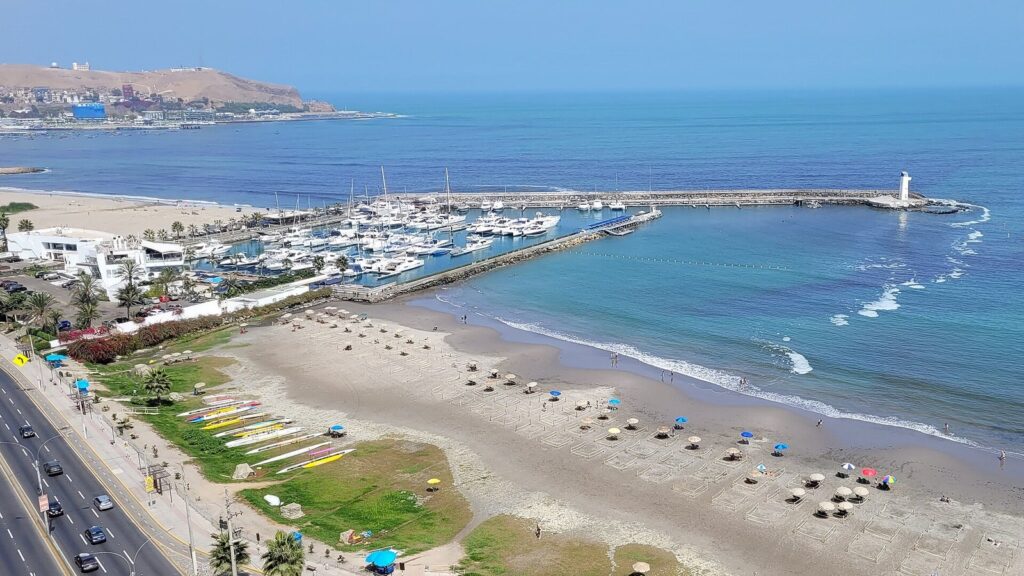
- Beach and marina below Barranco: photo by BBCLCD, Wikimedia Commons (CC BY-SA 4.0)
- Map of the day plans: Lima Tourism Guide, drawn from map data © OpenStreetMap contributors (ODbL)
- Municipal Palace, Plaza Mayor: photo by Pierre André Leclercq, Wikimedia Commons (CC BY-SA 4.0)
- Wari vessel, Museo Larco: photo by Unknown artistUnknown artist, Wikimedia Commons (CC BY-SA 4.0)
- Temple of the Sun, Pachacamac: photo by Arlette Rodriguez, Wikimedia Commons (CC BY-SA 4.0)
- Sea lions, Palomino Islands: photo by Kalitoddtravel, Wikimedia Commons (CC BY-SA 4.0)
- Plaza de Flores Metropolitano station: photo by TomasVial, Wikimedia Commons (CC0)